 From March 16th to the 18th, 3 teams from the University of Texas at Tyler competed among the top 58 Parliamentary Debate teams in the country at the 2014 National Parliamentary Tournament of Excellence. Dallas Flick and Carver Hodgkiss (UT Tyler HF), Stephen Hullum and Kaleb Drake (UT Tyler HD), and Sam Cook and Kaitlin Bull (UT Tyler BC) competed against the best of the best, ranking among the top 20 in the country.
Showing posts with label UT Tyler debate. Show all posts
Showing posts with label UT Tyler debate. Show all posts
Thursday, April 3, 2014
UT Tyler Debate Ranks Top 20 in Nation
From March 16th to the 18th, 3 teams from the University of Texas at Tyler competed among the top 58 Parliamentary Debate teams in the country at the 2014 National Parliamentary Tournament of Excellence. Dallas Flick and Carver Hodgkiss (UT Tyler HF), Stephen Hullum and Kaleb Drake (UT Tyler HD), and Sam Cook and Kaitlin Bull (UT Tyler BC) competed against the best of the best, ranking among the top 20 in the country.
Saturday, March 29, 2014
Debunking Debate: UT Tyler Competes at the NPDA Championship Tournament
 On Thursday, March 13th, the UT Tyler Parliamentary Debate Team traveled to Northern Arizona University in Flagstaff, Arizona, for our national tournaments: the National Parliamentary Tournament of Excellence, and the National Parliamentary Debate Association Championship Tournament. The trip lasted 11 days, consisting of 6 days of competition over both tournaments. Carver will be writing about the NPTE later this week, and I will be writing about the NPDA Championship Tournament.
The NPDA is often called "The People's Tournament," primarily stemming from it's sheer entry size and the propensity for underdogs to go very far in elimination rounds. The tournament consisted of over 150 teams from 52 different schools. There were eight preliminary rounds, followed by six elimination rounds, consisting of teams that had at least a 5-3 record in their prelim rounds.
 |
| UT Tyler FH |
After a rigorous set of preliminary rounds for all three teams, FH finished 6-2 to take the 18th seed in elimination rounds, BC finished 5-3 to take the 29th seed, and DH finished 5-3 to take the 33rd seed. It was a fantastic accomplishment to have all three teams break to elimination rounds, given the massive amount of competition at the tournament, as well as the relatively young nature of the teams that were competing for UT Tyler.
In the first elimination round, triple octo-finals, the resolution was "The United States Federal Government should significantly reduce its corporate tax rate." FH was affirmative against Texas Tech RR, BC was negative against Lewis & Clark GP, and DH was negative against Northern Arizona University RS. FH won their round on a 3-0, BC won on a 2-1, and DH lost in a very close round on a 2-1 decision. Carver and I are especially proud of Steven Hullum and Kaleb Drake for their performance at this tournament, seeing as they were two freshman who only debated together for three tournaments, including both national tournaments.
The second elimination round, double octo-finals, had the resolution "The United States Federal Government should significantly increase restrictions on domestic use of unpiloted aerial vehicles in U.S. airspace." FH was negative against Washburn KM, and BC was affirmative against Western Washington HT. Both teams were eliminated in this round: FH on a 3-2 loss, and BC on a 4-1.
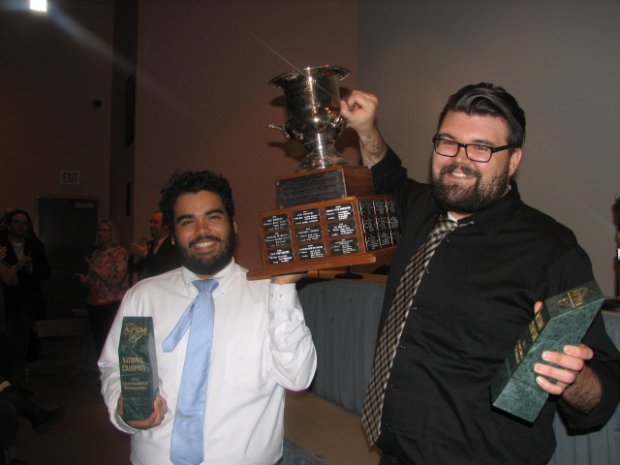 |
| NPDA National Champions from SIU, Josh Rivera and Ben Campbell |
Next year will be even better for UT Tyler Debate! If you want to have a better look at how the tournament played out over the three days of competition, you can see individual round results and cumulative results at parlitournament.com. There will also be videos uploaded on net-benefits.net from individual rounds in the NPTE and NPDA tournaments very soon. Support the UT Tyler Parliamentary Team in the 2014-2015 season!
Saturday, March 15, 2014
UT Tyler Debate Team Holds Demonstration Debate
 Interested in seeing what the UT Tyler Debate team spends so
much time doing? On March 5th, a demonstration debate featuring the
team was held at 5 PM in the administration building to give any interested
parties a look at what the team spends time preparing for.
Interested in seeing what the UT Tyler Debate team spends so
much time doing? On March 5th, a demonstration debate featuring the
team was held at 5 PM in the administration building to give any interested
parties a look at what the team spends time preparing for. Monday, March 3, 2014
UT Tyler Debate to compete at NPDA National Tournament
 While sports teams have their playoffs that drag out for
several weeks at a time, debate teams only have one big culmination of their
entire year. For UT Tyler, we compete at
two separate national tournaments that offer us a chance to win big against
other colleges across the country. From
March 21st until March 23rd, UT Tyler Debaters Dallas
Flick, Carver Hodgkiss, Steven Hullum, Kaleb Drake, Samuel Cook, and Kaitlyn
Bull will compete against over 150 other teams at the National ParliamentaryDebate Association’s (NPDA) National Tournament hosted by Northern Arizona
University in Flagstaff, Arizona.
While sports teams have their playoffs that drag out for
several weeks at a time, debate teams only have one big culmination of their
entire year. For UT Tyler, we compete at
two separate national tournaments that offer us a chance to win big against
other colleges across the country. From
March 21st until March 23rd, UT Tyler Debaters Dallas
Flick, Carver Hodgkiss, Steven Hullum, Kaleb Drake, Samuel Cook, and Kaitlyn
Bull will compete against over 150 other teams at the National ParliamentaryDebate Association’s (NPDA) National Tournament hosted by Northern Arizona
University in Flagstaff, Arizona.
Prior to competing at NPDA, the team will compete at the
National Parliamentary Tournament of Excellence (NPTE), also hosted by
NAU. You will be able to find Dallas’s
blog explaining that tournament soon if it is not already available.
There are a couple of differences between the two
tournaments. The first is the topics
that are debated. At the NPTE, every single topic of debate is announced
beforehand. In fact, we are already deep
into research and preparation for those topics as we speak. At NPDA, we have no clue what topics we will
be debating and we will not find out the given topic for each round until 20
minutes before the scheduled start time.
The second difference is the structure of the
tournament. At the NPTE, there are 6
preliminary rounds in which 2 judges will make a decision about the round. The goal for each team is to win as many
individual ballots from judges as they can in the first 6 rounds. For example, if you win your round on a 2 to
0 decision, then you have acquired 2 ballots.
If you win your round on a 1 to 1 decision, then you only have 1
ballot. A team has to have at least 6
ballots to advance to elimination rounds.
After the prelim rounds, the tournament then enters into a
double elimination style, where you can only lose 2 elimination rounds until
you are eliminated from the tournament.
This will continue until there are only two teams left in competition.
At NPDA, there are 8 preliminary rounds with only one judge
per round, so it is similar to the other tournaments that the team has attended
this year. After the 8 preliminary
rounds, half of the field will advance to a partial-triple-octafinal
round. NPDA elimination rounds are
single elimination, so if you lose once, then you are out of the
tournament.
The team hopes to achieve success, as we have been working
hard since July to hone skills, garner knowledge, and improve as debaters. Want
to monitor the teams progress at the NPTE? You can watch for UT Tyler FH, UT
Tyler DH, and UT Tyler BC on each individual round to see how we are doing!
Sunday, March 2, 2014
Debunking Debate- The NPTE
This year, the UT Tyler Parliamentary Debate Team has traveled to six different universities and competed in 9 tournaments, all of which were both challenging or rewarding. All of this effort, however, is to gain momentum for our toughest tournament of the year: The National Parliamentary Tournament of Excellence (NPTE).
The NPTE is an invitation-only national championship tournament that hosts teams that qualify based on their season-long performances at various tournaments. The point system utilized by the NPTE organization weighs the performance of the teams based on the number of preliminary and elimination debates won or lost at each tournament, as well as bonuses for breaking to elimination rounds, as well as winning the tournament. Seeding from these ranks determines who will be debating in the first round of the tournament (so, for instance, Carver and I already know that we will be debating The University of Utah in the first round of the tournament).
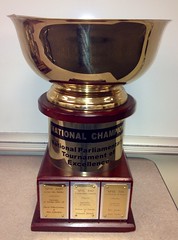 |
| The NPTE Championship Trophy |
The NPTE is a traveling tournament, meaning that each year, the event is hosted by a different university. For instance, in 2012 it was held at Western Washington University in Bellingham, Washington; last year, it was held at The University of Nevada, Reno, in Reno, Nevada; and this year, it is being hosted by Northern Arizona University in Flagstaff, Arizona. One of the best parts of this tournament is that it varies in location from year to year, providing a great opportunity for the debate teams to travel to locations in the United States they had never been.
Like previous tournaments, the NPTE will be a topic-area tournament. Like I wrote about in November regarding the Washburn Tournament, a topic-area tournament releases controversy areas and/or resolutions 3-4 weeks prior to the tournament, allowing for teams to adequately prepare for debates, as well as increase the depth and quality of arguments that will be read against other high caliber teams. The difference between the NPTE and previous tournaments is that while they release controversy areas, they also release the exact resolutions that will be used for the tournament. That way, the debaters know exactly what strategic options the other debaters have prior to the tournament.
Here is a list of the resolutions that will be used:
Africa
1. The United States federal government should fulfill the United Nations Multidimensional Integrated Stabilization Mission in Mali troop and equipment mandate.
2. The United States federal government should significantly increase unexploded ordnance cleanup efforts in Somalia.
3. The United States federal government should significantly increase its provision of disease monitoring and treatment to South Sudan.
4. The United States federal government should engage in significant civil society development projects within Libya.
5. The United States federal government should provide significant air support to aid in the stabilization of South Sudan.
6. The United States federal government should significantly increase access to neonatal and/or prenatal care in the Central African Republic.
Energy
1. The United States federal government should nationalize energy production in the United States.
2. The United States federal government should substantially increase its investment in hydroelectric power infrastructure projects in the United States.
3. The United States Department of Defense should adopt a policy to use exclusively renewable fuels in all military operations.
4. The United States federal government should increase the usage of microgeneration in the United States.
5. The United States federal government should increase its incentives for the development of methane hydrates within its exclusive economic zone.
6. The United States federal government should substantially increase its investments in syngas infrastructure in the United States.
Pollution
1. The United States federal government should adopt a policy to significantly decrease the use of phosphorus based fertilizers in the United States.
2. The United States federal government should adopt a policy to significantly reduce the amount of herbicides used in forests in the United States.
3. The United States federal government should take regulatory action to decrease the occurrence of water-borne diseases in the United States.
4. The United States federal government should significantly curtail its efforts to control invasive species.
5. The United States federal government should substantially increase environmental regulations on chemical storage facilities in the United States.
6. The United States should ratify and implement the Stockholm Convention on Persistent Organic Pollutants.
1. The United States federal government should fulfill the United Nations Multidimensional Integrated Stabilization Mission in Mali troop and equipment mandate.
2. The United States federal government should significantly increase unexploded ordnance cleanup efforts in Somalia.
3. The United States federal government should significantly increase its provision of disease monitoring and treatment to South Sudan.
4. The United States federal government should engage in significant civil society development projects within Libya.
5. The United States federal government should provide significant air support to aid in the stabilization of South Sudan.
6. The United States federal government should significantly increase access to neonatal and/or prenatal care in the Central African Republic.
Energy
1. The United States federal government should nationalize energy production in the United States.
2. The United States federal government should substantially increase its investment in hydroelectric power infrastructure projects in the United States.
3. The United States Department of Defense should adopt a policy to use exclusively renewable fuels in all military operations.
4. The United States federal government should increase the usage of microgeneration in the United States.
5. The United States federal government should increase its incentives for the development of methane hydrates within its exclusive economic zone.
6. The United States federal government should substantially increase its investments in syngas infrastructure in the United States.
Pollution
1. The United States federal government should adopt a policy to significantly decrease the use of phosphorus based fertilizers in the United States.
2. The United States federal government should adopt a policy to significantly reduce the amount of herbicides used in forests in the United States.
3. The United States federal government should take regulatory action to decrease the occurrence of water-borne diseases in the United States.
4. The United States federal government should significantly curtail its efforts to control invasive species.
5. The United States federal government should substantially increase environmental regulations on chemical storage facilities in the United States.
6. The United States should ratify and implement the Stockholm Convention on Persistent Organic Pollutants.
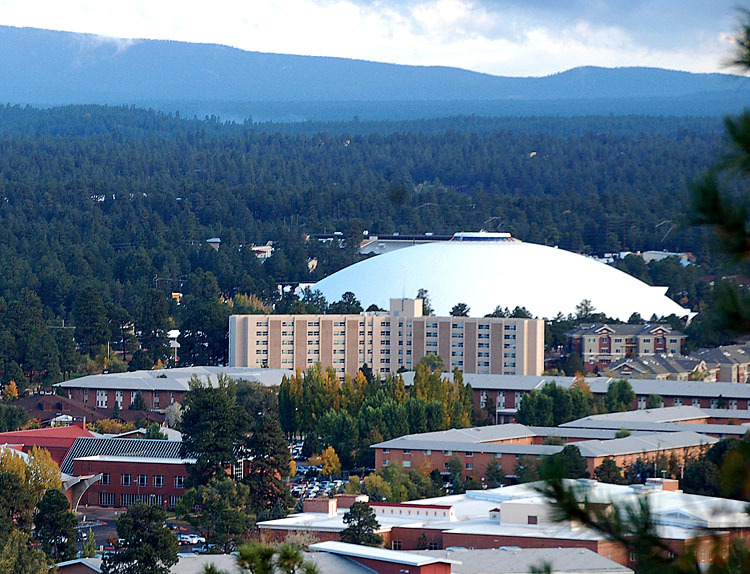 |
| Northern Arizona University, in Flagstaff, Arizona |
The tournament will begin on March 16th and end on March 18th. It begins with all teams competing in six preliminary rounds, with two judges in each round. Breaking to out rounds requires a certain minimum of ballots, determined by the number of teams at the tournament, how many are to break, and what the field looks like in terms of record throughout the tournament. Two years ago, the number needed to break was 7, and last year, it was 6. While that may seem easy, given that the majority of the teams at the tournament are highly experienced debaters, it makes into quite the challenge.
UT Tyler will leave for Flagstaff on March 13th, and will return on the 24th, following the second national tournament, the National Parliamentary Debate Association National Tournament. Keep up with results on a round-by-round basis at parlitournament.com, and also keep up with parli news and events at net-benefits.net.
Sunday, February 2, 2014
UT Tyler Debate Competes at the Mile High Swing
 |
| The University of Utah at Salt Lake City, Utah |
Last weekend, on January 18-20, the UT Tyler Parliamentary
Debate team traveled to the University of Utah in Salt Lake City, Utah to
compete at the Mile High Swing, a two-tournament weekend hosted by the
University of Utah and Texas Tech University. With over 90 teams in attendance, the tournament is considered to be the most challenging invitational of
the competition season, and is a strong predictor for how individual teams
perform at the national tournaments in March.
The tournament is called the “Mile High Swing” because it
was originally hosted at the University of Denver for a number of years, but
then became a traveling tournament. It was been hosted at venues such as Texas
Tech University, Western Washington University, Colorado College, and most recently,
the University of Utah.
The first tournament in the swing, hosted by Texas Tech
University, was a topic area tournament.
Like the tournament held at Washburn University in November, controversy
areas were previously announced for competitors to base their arguments
around. These were the areas debated in
eleven rounds of competition over a day and a half:
The United States federal government should substantially reduce
limitations on civil torts in the United States in one or more of the following
areas: statute of limitations on filings, availability of class action
lawsuits, caps on damages.
The United States federal government should substantially improve their relationship with the Republic of India in one or more of the following areas: immigration, trade, military sales, and/or minority relations.
The United States should adopt one or more of Robert McChesney’s proposals for mass media reform.
The United States federal government should substantially increase its oversight and/or restrictions on the National Security Administration and/or the Foreign Intelligence Surveillance Court.
The United States federal government should significantly increase regulations on securities and trades in the United States.
UT Tyler entered three teams in this tournament: UT Tyler FH
(Dallas Flick and Carver Hodgkiss), UT Tyler DH (Kaleb Drake and Steven
Hullum), and UT Tyler BC (Caitlun Bull and Sam Cook). In the first half of the tournament, BC and
DH broke to elimination rounds, both losing in the double octofinal round to
Texas Tech University and Northern Arizona University, respectively. In this tournament, the UT Tyler teams were
able to best teams from notable universities such as UC Berkeley, Air Force Academy
and the University of the Pacific.
The second half of the tournament was held in the
conventional tournament format, with topics that are not previously disclosed,
but instead based solely on current issues and events. The same three teams entered, and all three
broke to elimination rounds on the final day of competition. DH and BC both were bested in the
triple octofinal round by McKendree University and Point Loma University,
respectively, on a topic regarding ownership recognition of the Senkaku
Islands. FH won that round against the
University of Utah, and lost in the double octofinal round to William Jewell
College on a topic regarding removing the tax exemption of religious
institutions in the United States. In
this half of the tournament, UT Tyler conquered over teams from schools such as
the University of Colorado Boulder, University of Puget Sound, and the
University of Nevada at Reno.
 |
| Northern Arizona University at Flagstaff, Arizona |
The next tournament for the entire team will be our national tournament at Northern Arizona University in Flagstaff, Arizona- the National Parliamentary Tournament of Excellence. Tournament preparation will begin in late February, and the tournament begins on the last weekend of Spring Break. Keep up with results at parlitournament.com, and check out npte.debateaddict.com to see who will be competing in the tournament.
Friday, November 22, 2013
UT Tyler Debate competes at Washburn University Debate Tournament
 Last Friday, November 15th, at 7:00 AM, the
debate team from the University of Texas at Tyler departed for a 4 day trip to
Topeka Kansas where they competed at the Top City Classic Invitational Debate
Tournament at Washburn University. The tournament
began on Saturday morning at 8:00 AM, with 7 preliminary rounds that day, and
continued into Sunday, where there was an additional preliminary round followed
by elimination rounds.
Last Friday, November 15th, at 7:00 AM, the
debate team from the University of Texas at Tyler departed for a 4 day trip to
Topeka Kansas where they competed at the Top City Classic Invitational Debate
Tournament at Washburn University. The tournament
began on Saturday morning at 8:00 AM, with 7 preliminary rounds that day, and
continued into Sunday, where there was an additional preliminary round followed
by elimination rounds. Saturday, November 2, 2013
UT Tyler Debate Teams Rank among the nation’s best

Wednesday, October 23, 2013
UT Tyler Debate Travels to McKendree University
 On October 18-20th, the UT Tyler Parliamentary
Debate Team traveled to McKendree University for the Sixth Annual Bearcat
Classic and Richard Hunsaker Invitational Debate Tournaments. Located in Lebanon, Illinois (30 minutes east
of St. Louis), McKendree University has been a regular tournament for UT Tyler
for over four years, and it carries a consistent level of competition and
excitement for our debate teams.
On October 18-20th, the UT Tyler Parliamentary
Debate Team traveled to McKendree University for the Sixth Annual Bearcat
Classic and Richard Hunsaker Invitational Debate Tournaments. Located in Lebanon, Illinois (30 minutes east
of St. Louis), McKendree University has been a regular tournament for UT Tyler
for over four years, and it carries a consistent level of competition and
excitement for our debate teams.
Historically, the McKendree swing tournament consists of the
most competitive parliamentary debate teams from the Midwest, and has often
been an indicator for who performs well at both of our national tournaments
(National Parliamentary Tournament of Excellence and the National Parliamentary
Debate Association Tournament). While
the quantity of teams is lower than most tournaments (roughly 33 teams in both
halves), the quality of competition is high, as a large portion of the teams
have placed in the top twenty of nationals in the past two years.
The first half of the tournament, the Bearcat Classic, had
33 teams from 7 different universities and colleges, and consisted of five
preliminary rounds and five elimination rounds.
UT Tyler entered three teams in the tournament: UT Tyler FH (Dallas
Flick and Carver Hodgkiss), UT Tyler BC (Kaitlyn Bull and Sam Cook), and UT
Tyler HM (Steven Hullum and Taylor Manatsa).
After prelims, UT Tyler FH went 4-1 and was 6th seed going
into elimination rounds, BC went 5-0 and was 1st seed in elimination
rounds, and UT Tyler HM went 2-3 and did not break to elimination rounds. However, they did compete in the JV breakout
rounds for the JV debaters who did not break into out rounds, and finished in
second place. After elimination rounds,
FH finished in octofinals, while BC finished in quarterfinals.
In the second half of the tournament, the Hunsaker
Invitational, the same three teams competed against the same level of
competition. All three teams broke to
out rounds in the second half, with FH going 3-2 and earning the 9th
seed, BC going 5-0 and earning 1st seed, and HM going 3-2 and
earning 16th seed. In out
rounds, HM finished in partial octofinals, FH finished in quarterfinals, and BC
lost in finals to Washburn University to earn second place in the tournament.
The next tournament for the UT Tyler Debate Team will be the
Top City Classic at Washburn University, located in Topeka, Kansas. To keep up with tournament results from past
and upcoming tournaments, check out Parli Tournament for live updates, and
check out npte.debateaddict.com to see rankings for debate teams nationwide.
Tuesday, October 15, 2013
UT Tyler Forensics goes to Portland, Oregon!
 |
| UT Tyler FH vs. Lewis and Clark MH |
Wednesday, October 2, 2013
UT Tyler Parliamentary Debate Team- William Jewell College Season Opener
On September 20-22nd, the UT Tyler Parliamentary Debate Team
traveled to Liberty, Missouri for the William Jewell College Season
Opener. It was a “swing,” meaning that
there are two separate tournaments in one weekend. With over 50 teams entered from 18 different
colleges and universities, UT Tyler had a very strong showing with the four
different teams entered in both tournaments.
 |
| UT Tyler FH v. Univ. of Pacific HR |
The first half of the Jewell opener, the Gina Lane Classic,
named after the former Director of Forensics at Jewell and current board member
in the National Parliamentary Tournament of Excellence. UT Tyler entered three teams in this half: UT
Tyler FH (Dallas Flick and Carver Hodgkiss), UT Tyler BC (Kaitlyn Bull and Sam
Cook), and UT Tyler HM (Stephen Hullum and Taylor Manatsa). The format for this tournament includes five
preliminary rounds, and then elimination rounds for teams with winning records
in the preliminary rounds. UT Tyler FH
and UT Tyler CB had 4-1 records in the preliminary rounds, earning them spots
in elimination rounds, and a bye through the partial octofinals round. UT Tyler HM went 1-4 in the preliminary
rounds, which meant they would not compete in elimination rounds, but they
still competed very well. In elimination
rounds, UT Tyler BC lost in their octofinals round to the top team from
Washburn University. UT Tyler FH lost in
quarterfinals to the top team from Mckendree University. Kaitlyn Bull was the 18th top
speaker in the first half of the tournament, and I was the 17th top
speaker. Overall, it was a very strong
season opener for UT Tyler.
 |
| UT Tyler EH (right side) v. Long Beach HM |
The second half of the Jewell opener, the Georgia Bowman
Tournament, had the same format as the Gina Lane Classic, and UT Tyler entered
three teams in the Open Tournament, and one student in the JV Tournament. In open, UT Tyler FH, UT Tyler BC, and UT
Tyler EH (JH Engelbrecht and Steven Hullum) competed. In the JV tournament, Taylor Manatsa debated
with another novice from William Jewell University, Josi Plyman. In the preliminary rounds, UT Tyler FH went
3-2, allowing for entry in the elimination rounds. UT Tyler BC and EH both went 2-3, keeping
them out of the elimination rounds, but they still performed very well in the
second half. Finally, in JV, UTT/WJC MP
went 3-2, allowing them to compete in the JV elimination rounds.
In elimination rounds for the second half, UT Tyler FH won
the partial octofinals round, and then lost in octofinals to the top Mckendree
team. For the JV tournament, UTT/WJC MP
lost in the semifinal round to Texas Tech.
For junior varsity debaters, Taylor Manatsa was the 10th top
speaker for the second half. For the
open debaters, Carver Hodgkiss was the 20th speaker, and I was the
10th top speaker. UT Tyler
had a strong second half, and overall the William Jewell College Season Opener
was a huge success! If you want more information about the tournament or specific details on how other teams performed check out the tournament pages: Gina Lane Classic, Georgia Bowman Tournament.
The next tournament for UT Tyler takes place at Lewis and Clark College on October 12th, and it will be a very challenging tournament. Keep up with the UT Tyler Student Blog to find the results for the tournament! Also, for live updates for the tournament, check out www.parlitournament.com and keep up with UT Tyler’s progress!