At UT Tyler, it is not difficult to guess the comparative rate of pay for faculty, staff, and administration members. Pay increases as it normally would in a Division 3 institution, with the president of the university holding the most impressive pay stub, and a decreasing number as you move down the hierarchy of command and control. There obviously exists a direct relationship between rate of pay and authority at UT Tyler, but do other public universities have the same relationship with their staff and administration?
 Not surprisingly, the answer is no. The Chronicle of Higher Education shared a survey on executive compensation on May 18th indicating that head coaches for football and basketball often carry higher salaries than the university's president and other high-status administration members. This trend occurs in more than 40 states, reflecting the subjective importance of sports for larger universities in the United States. This comparison occurs quite often within academic circles, as they weep helplessly as the coach of a sports team gets paid more than the professor or administrator that actually gives the institution the "higher education" qualification.
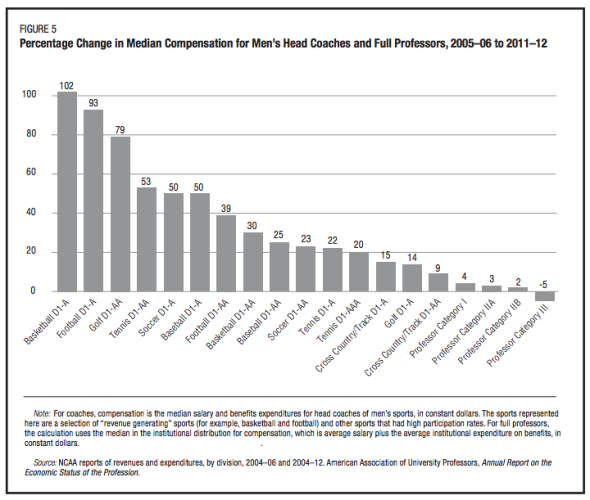 |
| NCAA reports of revenues and expenditures by division, courtesy of Slate |
It should be noted that many coaches' salaries are paid in part by athletic foundations with a hefty alumni base, so their pay comes not from tax payers, but rather former students at each university. But does that really justify their high pay? Alumni donations going toward improvements to sports facilities and high salaries for coaches means there is a large opportunity cost with not giving that money for actual academics. I'm not saying that the NCAA should be scoffed at, but rather prompting a reevaluation of our priorities within higher education institutions. UT Tyler seems to have their priorities in order; while extra-curricular activities and sports teams have large support from the administration and alumni organizations, there exists a substantial dispersion of funding to academic facilities and programs. But for other institutions in the US, priorities seem to be out of sync.

