Showing posts with label dflick. Show all posts

Thursday, July 17, 2014

So Long, and Thanks For All the Fish


Thursday, July 17th, 2014 will be my final day working for the UT Tyler Admissions Call Center. While my time here seems to have been short, I have enjoyed every moment of working in this office. I have been extremely proud of giving back to my university by spreading the word about how much this institution has to offer to new students. This school has given me so much--an affordable education, a great debate team, great classes and professors, and a great office to work in--and I am extremely gracious to have been able to give back.

Starting mid-August, I will begin working at the Literacy Council of Tyler as a Student Intern, where I will have the opportunity to tutor students enrolled in GED and ESL programs. While I have enjoyed my time expressing to potential students the benefits of enrolling at UT Tyler, this job will give me an opportunity to work with students who need more help than others. I have large respect for those who commit to getting their GED so they can accomplish more with their life, and I love that I get to help these students achieve their short- and long-term goals.

The past year and two months in this office has been extremely memorable. I have met new friends, had great bosses, and the experiences I have shared with them here will go unparalleled in the future. Alas, the opportunities that I have been offered in my new job are too enticing to pass up, and I wish to take my talents to this office to tackle new challenges and make new memories while I still have a year left at UT Tyler.

I will miss speaking with potential students about attending UT Tyler and the opportunities available to them at this wonderful institution. I will miss blogging about debate, events at UT Tyler, the wondrous world of academia, and the opportunities available at UT Tyler. I will miss the shenanigans in the Call Center, such as yelling at Carver and Kevin from across the room. I will miss the friendly environment, the accommodating staff that oversees our office, and the opportunities that they presented us to better ourselves both in and out of the workplace. I will miss the Call Center quite a bit once I leave.

Alas, it is time to go. So Long, and Thanks For All the Fish.

stephen colbert animated GIF

Wednesday, July 9, 2014

Relax UT Tyler Grads, Finding a Job Might Not Be Too Difficult


In the wake of the 2008 economic recession in the United States, Americans found post-secondary education to be more appealing, a better option than trying to jump directly into a faulting job market. The Lumina Foundation found in April that there is a steady increase in college enrollment and the attainment of college degrees, approximately 0.7% per year, higher than at any point before the recession. Individuals found college to be a safer investment than simply jumping into the job market--in mid-2014, is this still the situation?


FiveThirtyEight blog posted new analysis on Tuesday, July 8th that indicates that job openings in the United States are increasing, and those seeking new employment face their best odds now than at any other point during the economic recovery. According to Ben Casselman, FiveThirtyEight blog's chief economics writer, finds that more U.S. companies are hiring new workers. Specifically, the Bureau of Labor Statistics notes that 4.6 million job openings were posted in the month of May, up 19 percent from this point last year. This is good news for recent college graduates, as the likeliness of finding employment straight out of their undergraduate or graduate work is higher now than at any other point during the U.S. economic recovery.

The report also shows that layoffs are at a near all-time low, at least since 2001, when the government started keeping track of layoff rates in the United States. An even better indicator of workers' confidence is the rate of voluntary quits in the job market, which is at an all time high. This means that employment attrition is less of a concern than it was just a few years ago--a new college graduate out of UT Tyler can leave the school with more confidence that they will find gainful employment in their field, and keep that employment for the long term.

Rising openings and falling layoffs indicates a lack of competition for employment positions in a new graduate's particular field, a good sign for those concerned that they would not find a job in the area of their collegiate study. While this means that the college investment was a smart choice for recent graduates, it does not mean that college is less of a strong option for those still in high school. While employment opportunities might be increasing right now, the report does not indicate the level of recent education required to acquire these positions. This means that those in their senior year of high school should continue to highly consider pursuing a college degree, as it is still the safest investment following your high school graduation.

Monday, July 7, 2014

UT Tyler to Host Supreme Court Justice Clarence Thomas


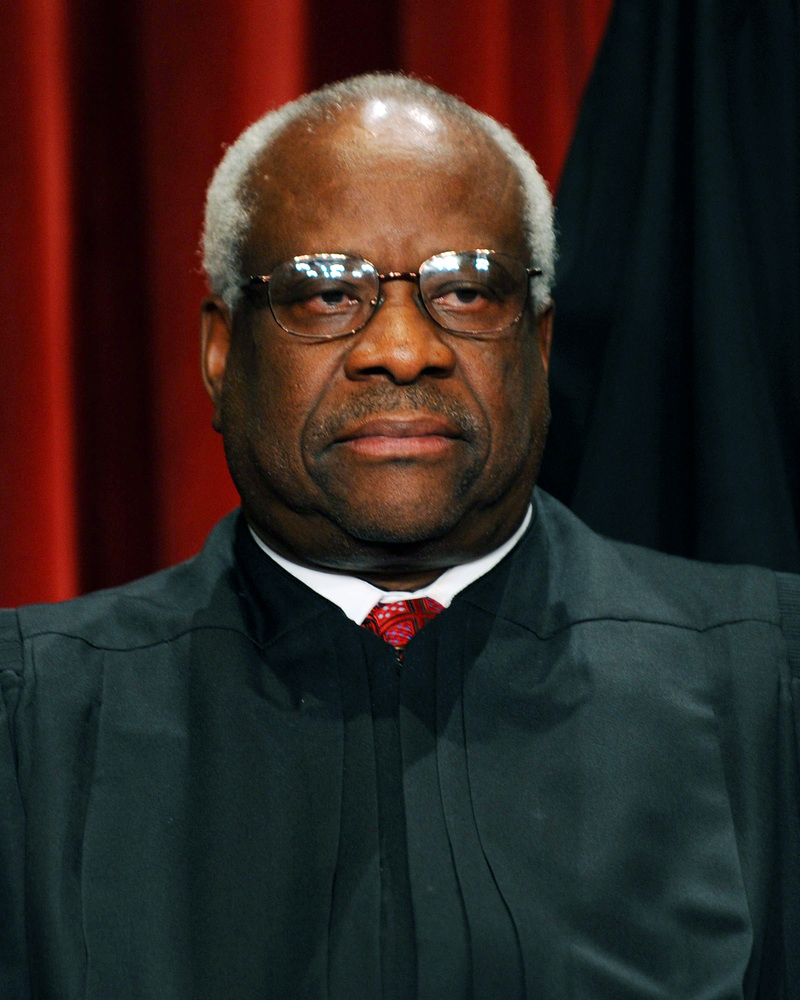
US Supreme Court Associate
Justice Clarence Thomas
This September, the Cowan Center will host US Supreme Court Associate Justice Clarence Thomas as part of the UT Tyler Distinguished Lecture Series. This will be the first time a Supreme Court Justice visits UT Tyler, and Justice Thomas will be the opening lecture for the 33rd year of the UT Tyler Distinguished Lecture Series.

Justice Thomas was born in 1948 in Pin Point, Georgia, a community near Savannah, Georgia. He attended Conception Seminary and received an A.B., cum laude, from Holy Cross College in Worcester, Massachusetts. He went on to receive his J.D. (Juris Doctor---law degree) from Yale Law School in 1974.

Following his academic career, he was admitted to the Missouri bar in 1974, and for the next three years, he served as the Assistant Attorney General of Missouri under State Attorney General John Danforth. In 1976, Justice Thomas took an attorney position with the Monsanto Company in St. Louis, Missouri. In 1979 he returned to work with now U.S. Senator Danforth through 1981 as a Legislative Assistant. He then joined the Reagan administration in 1981 as the Assistant Secretary of Education for the Office for Civil Rights in the U.S. Department of Education, and then in 1982 through 1990 he was the Chairman of the US Equal Employment Opportunity Commission.

In 1989, President George H.W. Bush nominated Thomas to a seat on the US Court of Appeals for the District of Columbia. Following his tenure on this bench, President Bush nominated him for the Supreme Court in 1991, following the retirement of Thurgood Marshall, the first African American to serve as a Supreme Court Justice in the United States. Thomas would go on to be the second African-American on the bench, and he still holds his seat on the bench today.

His public perception is one that is somewhat shrouded in mystery. He is seen as having joined the conservative wing of the Court, being seen by some as the most conservative member of the Supreme Court; others argue that Justice Scalia holds that honor. Both men view themselves as originalists, making some of their decisions on the bench highly controversial. One of his most distinguishing features on the bench is his silence--Supreme Court Justices are often very talkative  during opening statements for cases, but Justice Thomas does not speak. Recently he did speak up briefly during opening statements and arguments for the first time in seven years, just so he could make a joke about the two lawyers that were alumnus from Harvard and Yale Law School.

His resonating silence on the bench makes an entire lecture from him at UT Tyler much more exciting. Tickets will go on sale for the public in August from the Cowan Center website, so be sure to claim your seats while they are open!

Friday, July 4, 2014

How UT Tyler Can Help Students Better Understand Their Finances


In my last blog entry, I noted that one of the largest hurdles for undergraduates in their first year of college life is the ability to retain financial support to continue their academic career. In fact, it is the leading cause of low retention rates for colleges and universities in the United States. While a large portion of this issue is based on socioeconomic status, a large amount of relief for this problem can come from having a better understanding of one's finances. Whether it is being able to pay for one's tuition, or just being able to make rent payments on a monthly basis, it is no surprise that undergraduate students could always use more assistance with financial solvency.

New strides are being made with colleges and universities nationwide to alleviate the stresses that come with dealing with a student's personal finances. Many colleges have started financial literacy programs in recent years, some even making these courses and programs a requirement to enroll for classes for subsequent semesters. These programs are necessary based on the average knowledge that undergraduate students have about personal finance--concepts such as budgeting, saving, compound interest, and even check-writing are becoming more unknown for these students. Rather than wasting money on a regular basis on luxuries such as video games, furnishings, alcohol, etc., students can learn how to better save their money to have an easier time making their required payments.

UT Tyler can adopt a framework similar to that of Ohio State University, who are currently in the process of making all students complete a financial-education program during their second year at the school. The mandate requires students to review online material, as well as meet one-on-one with a student financial adviser. These volunteer advisers are trained to spend time with students to help them understand their current financial situation, establish goals for the short and long term, and develop sustainable financial habits and responsibilities. The overall goal is to better inform students as to how they can better their financial responsibility, and make college life easier and more sustainable.

While UT Tyler has the ability to boast an extremely affordable tuition rate that is well below the state median for public university tuition, financial woes for some students still exist. The responsibility for financial stability and success does not have to fall solely on the student--our university can make large strides as well. Until then, there is a litany of resources that can be utilized, both in person as well as on the internet. FAFSA has a large information basis for students applying for financial aid, and UT Tyler provides financial aid advising for its students who require more information. Check it out before your next rent check is due!

Thursday, June 26, 2014

The Potential for Cell Phone Connectivity at UT Tyler


One of the most important areas of discussion for colleges and universities is retention rates, primarily calculated by the average amount of freshman students that return to the same university for their sophomore year. UT Tyler's retention rate is roughly 64 percent, roughly 13 percent below the national average, and 11 percent below the state average. the average retention rate in the United States. Reasons for this trend among students include academic difficulty, family problems, and loneliness, but the most cited reason is money-related issues. Specifically, one reason for these issues lie with student's lack of reapplication for financial aid and scholarships through the government and their university. A study finds that more than 18 percent of students that receive a Pell Grant in their freshman year (a group that earned an average 3.0 GPA in their freshman year) fail to reapply for the grant in their sophomore year. As a result, half of those students did not return to their university in their sophomore year. A question arises from this startling statistic: Would encouraging students to reapply for financial aid increase their academic persistence, and in turn, a university's overall retention rate?

To tackle this problem, Ben Castleman and Lindsey C. Page, assistant professors of education that penned the previously mentioned study entitled "Here Today, Gone Tomorrow? Investigating Rates and Patterns of Financial Aid Renewal Among College Freshmen", designed and implemented a system of text-message reminders for students with the intention of reminding them to reapply for financial aid at the end of their second semester during their freshman year. These texts gave reminders about refiling their FAFSA applications, as well as maintaining satisfactory academic achievement in order to continue receiving financial aid and scholarships during their academic careers. The results, according to the study, show that the majority of improvement lied within community college student populations, whose retention rate was at 76 percent, 12 percent higher than students within the control group that did not receive the text messages. However, this study shows no significant changes for students attending four-year universities. Explanations for this lack of improvement from the author's include the already existing "passive" reminders that universities use, such as putting up flyers that remind students to refile their FAFSA application, along with the lack of a broad search during the experiment--researchers used colleges and universities in Massachusetts for their study, a state that has higher average retention and graduation rates than the majority of other states. 

Knowing that these methods have potential among students at both four-year universities and community colleges, it is worth considering the growth potential for cell phone connectivity at UT Tyler. As of now the university uses text reminders and alert systems for their students for various purposes, but the utility of academic and financial aid reminders could boost retention rates, average GPA values across different classes and schools, along with a litany of other benefits. The use of text messaging is at an immense high among college students nationwide, so the potential for improvement of its use can massively increase for our university. 

Thursday, June 12, 2014

Who's Paycheck is Higher in Public-College Institutions?


At UT Tyler, it is not difficult to guess the comparative rate of pay for faculty, staff, and administration members. Pay increases as it normally would in a Division 3 institution, with the president of the university holding the most impressive pay stub, and a decreasing number as you move down the hierarchy of command and control. There obviously exists a direct relationship between rate of pay and authority at UT Tyler, but do other public universities have the same relationship with their staff and administration?

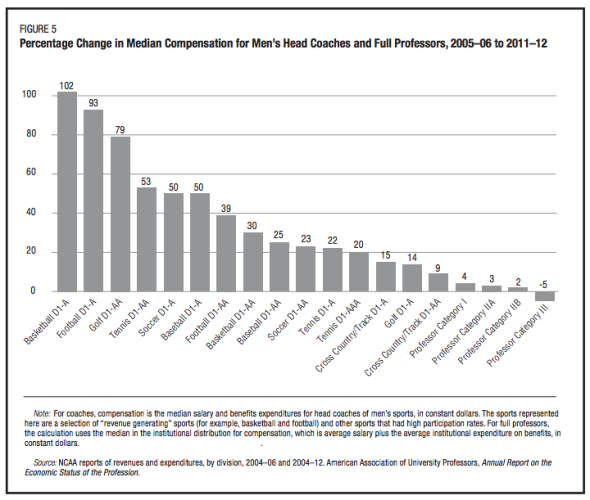
477365957-head-coach-mike-krzyzewski-of-the-duke-blue-devilsNot surprisingly, the answer is no. The Chronicle of Higher Education shared a survey on executive compensation on May 18th indicating that head coaches for football and basketball often carry higher salaries than the university's president and other high-status administration members. This trend occurs in more than 40 states, reflecting the subjective importance of sports for larger universities in the United States. This comparison occurs quite often within academic circles, as they weep helplessly as the coach of a sports team gets paid more than the professor or administrator that actually gives the institution the "higher education" qualification.
screen_shot_20140407_at_9.34.07_am
NCAA reports of revenues and expenditures by division, courtesy of Slate
At some colleges, coaches' compensation can be more than $500,000 more than a university president or other chief-executive position. That's more than double the president's salary at a typical institution. What is the utility for this type of pay distribution? Should a coach have a higher pay rate than those who keep the university running on an academic level?

It should be noted that many coaches' salaries are paid in part by athletic foundations with a hefty alumni base, so their pay comes not from tax payers, but rather former students at each university. But does that really justify their high pay? Alumni donations going toward improvements to sports facilities and high salaries for coaches means there is a large opportunity cost with not giving that money for actual academics. I'm not saying that the NCAA should be scoffed at, but rather prompting a reevaluation of our priorities within higher education institutions. UT Tyler seems to have their priorities in order; while extra-curricular activities and sports teams have large support from the administration and alumni organizations, there exists a substantial dispersion of funding to academic facilities and programs. But for other institutions in the US, priorities seem to be out of sync.

Friday, June 6, 2014

Summer Reading List (no picture books, unfortunately)


I am terrible at reading. It is not that I cannot actually read, otherwise it would be a miracle that I can write this whole sentence with correct punctuation. The issue lies with my inability to stay focused on a piece of literature long enough to actually get to the last page. It's either my short attention span, or the large amount of work that comes with the school year. So every summer, when boredom rolls around, I make a short reading list, consisting of three to four books that deal with my personal interests, academic-related content, reading material for debate, or books that are currently being adapted to a television show on HBO (a fairly obvious selection). I read as many as possible before I eventually flake and go back to playing video games. Regardless, here is my reading list for the summer. Feel free to steal one of my choices for your own summer list.
File:Machiavelli Principe Cover Page.jpg
Title page of a 1550 page of The Prince 

The Prince, by Niccolò Machiavelli

Considered to be one of the first works of modern philosophy, The Prince continues to be one of the most influential pieces of literature among academics, students, and political enthusiasts in the contemporary era. Written by Niccolò Machiavelli and published in 1532, The Prince evaluates the role of leadership and rule within a political society, and determines that the aims of princes--such as glory and survival--can justify the use of immoral means to achieve those ends. It is one of the earliest depictions of political and societal realism, and is a must read for any political science, history, and philosophy students during their time within academia.     

Resistance, Rebellion, and Death, by Albert Camus 

Last summer, I managed to finish a whole book on my summer reading list (this is a huge accomplishment for me). Unfortunately, finishing the book caused me to have a minor existential crisis, a common effect of reading The Stranger by Albert Camus. Considered to be one of the greatest authors of all time, French Nobel Prize winning author, journalist, and philosopher Albert Camus' heavy contribution to 20th Century literature revolutionized what we now know as absurdism and existentialism. His next work on my list is Resistance, Rebellion, and Death, a collection of essays published in 1960 that covers themes such as freedom, rebellion, capital punishment, totalitarianism, and others that are common centerpieces within political science, history, and philosophy discussions. A good read if you feel like thinking real deep and stuff.

The Nine, by Jeffrey Toobin


Sandra Day O'Connor, former Supreme Court Justice
who plays a large role in The Nine
Jurisprudence is a tricky subject; only a select few can stomach its intricacies, and even fewer do not find it horrendously boring. Within this study of the law and its evolution lies a continuing conversation regarding the makeup of the U.S. Supreme Court, and how its ruling pattern has changed throughout its existence. While most Constitutional Law courses you take in your undergraduate career will cover relevant cases, not often is there a hyper-specific look into the lives and careers of the Supreme Court Justices within the contemporary era. Toobin's The Nine profiles the justices of the United States Supreme Court within the past sixty years, discusses the function of the institution during an important era of social equality and justice, and how the jurisprudence of the branch and its members has changed over the years. It takes a specific look to the conservative revolution that took place within the court after the 1973 ruling of Roe v. Wade, and the key players that created permanent change to the bench, and what those changes mean for society in our current era. A great read for those who crave C-Span and watching old people deliberate on subjectively important matters.

A Song of Ice and Fire, by George R. R. Martin

Among fans of the popular HBO show Game of Thrones, I fall into the category of "non-book readers." That means all of the incredibly surprising, gut-wrenching events the show throws at me are completely unpredictable. Because this book series has been around since 1996, spoilers for the show are fairly common, and the guilty party is often someone who read all the books before the show started and ruin it for the non-book readers. Well, I am personally tired of the spoilers, and I know that they will inevitably continue so long as Facebook, Twitter, and Reddit continue to exist. So, to avoid the painful process of avoiding spoilers week-by-week, I decided that once Season Four of the show ends (two episodes remaining), I will try to read the books (again, like, for the fourth time).


Saturday, May 24, 2014

Admissions Tests for Postgraduate/Professional School: Irritating, But Not Impossible


I made the decision earlier this week to pursue a dual degree program at UT Austin once I finish with my undergraduate degree at The University of Texas at Tyler. It consists of courses that work toward a Master of Public Affairs Degree (MPAff) and a Law Degree (J.D.-Doctor of Jurisprudence). The process requires three years of coursework, and is considered a grueling, but rewarding endeavor for students who wish to work toward a specific field in domestic public policy and legal matters. In order to get into this program, however, I have to score well on both the GRE and the LSAT, both required to get into the LBJ School of Public Affairs and the UT School of Law, respectively. When I told this to an admissions worker at the LBJ school, I was told that I was "a glutton for punishment." I'm not sure if she was referring to the actual coursework, or the requirement of taking two postgraduate admissions tests within a six month time frame.

This is a pretty rare case, as most students that seek a Masters degree or professional degree rarely take more than one admissions test to continue on after their undergraduate degree is completed. These tests vary based on the school/profession you seek: for instance, you can take the Graduate Record Examination (GRE), the Medical College Admissions Test (MCAT), the Law School Admission Test (LSAT), etc. Regardless of what test you need to take, they all require an ample amount of studying and preparation in order to do well.

Most undergraduate students can recall taking the SAT and/or ACT prior to their admission to a college or university; specifically, the amount of stress and energy that goes into preparing for the standardized admissions tests. Students often take prep courses for these tests, they study manuals and test handbooks sold by companies such as The Princeton Review, and some even avoid studying completely. The same process exists for postgraduate and professional school admissions tests--a lot of studying, a lack of sleep, and an abundance of caffeine to keep on churning. However, the difficulty at this level is a lot higher than for tests like the SAT, as the knowledge and critical thinking requirement for grad school is elevated significantly in order to challenge students and retain exclusivity.

It is important to keep the similar study habits with these tests as you had with your SAT/ACT in high school. Take a prep course, take practice tests on your own, etc. This form of preparation greatly benefits you on test day, as you are aware how the test is structured, what the methodology is for the various question types and sections on the test, and how to optimize your score to improve your image with the grad school you wish to attend. Personally, I know that I want a GRE score above a 160 (the scale is 130-170) and an LSAT score above a 165 (the scale is 120-180). I set these standards for myself based on the school that I wish to attend and their average scores for the exam for those that are accepted. For instance, the LBJ School of Public Affairs reports their average GRE scores for accepted students to be the following: 160 on the GRE Verbal (83rd Percentile), 156 on the GRE Quantitative, and a 4.4 on the GRE Writing. For the UT School of Law, their average LSAT score is around 167.

Keep in mind that school consider more than your admission test scores are not the only thing considered by grad schools. They also take into consideration your GPA, letters of recommendation, the list of classes you took as an undergrad student, etc. However, the importance of these tests are increasing within admissions offices nationwide. So, break out those prep books and get cracking!

Tuesday, May 13, 2014

E-Cigarette Use at UT Tyler


There exists a general consensus that smoking cigarettes on a regular basis leads to long-term decline in one's health. According to the Center for Disease Control, smoking regularly increases the risk for coronary heart disease, lung cancer, cardiovascular disease, and it causes more than 480,000 deaths in the United States every year. A common response to these risks for smokers is to go cold turkey, use nicotine gum or patches, and other methods to ween off the harmful aspects of cigarettes. A more common approach as of late, however, is the use of e-cigarettes.

Electronic cigarettes, or e-cigarettes, are battery-powered devices that simulate tobacco smoking through the production of a vapor, similar to smoke from a cigarette or a cigar. It contains an atomizer, a heating element that vaporizes a liquid and creates the vapor. The liquid can be purchased at specialized stores, and it may or may not contain a mixture of nicotine. The use of the nicotine is to supplement the nicotine found in common cigarettes, while avoiding the main health risks carried in normal cigarette smoking.

There is currently a debate over the use of e-cigarettes, including the benefits and risks that come with their continued use, along with their use in public settings, such as in universities. Given that their use contains a risk of nicotine addiction, which is normal for those who previously smoked cigarettes. However, the possible nicotine addiction warrants government regulation, as seen with last month's announcement of new FDA regulations on the advertising and sale for their use. On a smaller scale, various organizations, schools, universities, and public buildings have began regulating their use as well. For example, Smith County announced that e-cigarette use is prohibited within and outside county facilities, such as court houses and government offices. Some universities in the United States, such as Northern Arizona University, bans their use within campus buildings, while other universities, such as UT Tyler, regulates their use in certain buildings and classrooms.
Jury is out on health effects of e-cigarettes

At UT Tyler, the use of e-cigarettes is regulated on a building-by-building basis. For example, the University Center bans their use within the building, as well as in adjacent buildings. Other buildings, such as the Business Building, allows their use at the discretion of the teacher/professor teaching a class. I personally have had only one professor tell me that I cannot use my e-cigarette in a class, but the others allow my continued use on the condition that it does not disturb the other students in the class. However, if a certain college within the university wanted to ban their use, it would affect the entire building in which they are housed.

This might change in the near future, as there is the discussion within the UT Tyler Administration to ban their use throughout the whole campus, much like other universities have mandated. This could easily occur as soon as the Fall of 2014, but that solely depends on if the administration believes their use within classrooms and other parts of campus buildings is a detriment to students and faculty. If you commonly use e-cigarettes at UT Tyler, be mindful that this change may come within the next few months.

Monday, April 14, 2014

UT Tyler Holds Its Annual Crawfish Boil at Harvey Lake

On Monday, April 14th at The University of Texas at Tyler, the Office of Marketing and Communications hosted its annual Crawfish Boil at Harvey Lake deck, one of the kick-off events for Student Appreciation Week, an event that runs all week (April 14th through 18th).


Despite the cold and rain, hundreds of students began lining up before the actual start time of 11:30 for the lunch. The crew in charge preparing and serving the crawfish began setting up for the event well into the morning, graciously braving the cold weather to provide the students with an excellent free lunch. They cooked hundreds of pounds of crawfish, corn on the cob, and potatoes today, and for that we are extremely grateful.


Hundreds of students were eager to eat, as the line ran from the source of the food all the way to the cashier's office, and even longer after students got out of their morning class to make their way to the food. The 10+ minute wait was well worth it, because the crawfish was ridiculously good. Definitely worth going next year if you missed it on Monday!

Go to more events this week for Student Appreciation Week! There will be events on campus, such as movie nights and sports games all week, as well as many more fun things to do, all for the students at UTT!

Saturday, April 12, 2014

Economic Analyst from the Federal Reserve Bank of Dallas Lectures at UT Tyler


On Wednesday, April 9th, Senior Economic Education Specialist Princeton Williams from the Federal Reserve Bank of Dallas lectured to several classes within the Economics Department regarding the Federal Reserve Bank in Dallas, and the overall Federal Reserve in the United States and its role within the United States economy. 

Williams joined the Federal Reserve Bank of Dallas in 2006 as senior economic education specialist. Prior to holding this position, he was a high school economics teacher who taught AP macroeconomics and AP microeconomics at Paschal High School in Fort Worth. He coauthored the district's economics curriculum, mentored new economics teachers, and conducted citywide review sessions for AP students.  Williams received a BBA from Southern Methodist University and a MA in economics from the University of Texas at Arlington. During his graduate studies, he interned in the economic and market analysis division of the U.S. Department of Housing and Urban Development. 

Federal Reserve Bank of Dallas 
Williams' position in the Federal Reserve Bank of Dallas consists primarily of public affairs work. He often lectures high school and college students about the utility of the Federal Reserve, and the common misconceptions that the public has about the function of the Federal Reserve. He also leads teacher workshops in the state to improve the economics curriculum within the Texas school system, and he is currently creating an economics curriculum for middle school students in Texas. He also does analysis work over academic work written by economic theorists, mainly by bridging the gap from academia to the public, where said work can often be misconstrued or misinterpreted due to a lack of education in that particular field. 

In the class I was in where he lectured, Issues in Public Policy, several points of discussion were covered. We first discussed the utility of Bitcoin, digital currency that is gaining momentum within the U.S. economic system. Williams finds that the fluid nature of Bitcoin and the uncertainty regarding its value on a day-to-day basis makes it a somewhat unpredictable and possibly unstable alternative for investment in the U.S. We also covered the security of the Federal Reserve Bank in Dallas, where rumors and perceptions of "bank heists" that occur in popular entertainment (Die Hard With a Vengeance, for example), are entirely unfeasible.

Next, there was a discussion over the new Federal Reserve Chairwoman, Janet Yellen; primarily, her strengths and weaknesses within that position in comparison to former Fed chair, Ben Bernanke. Finally, there was a hefty talk over the fiscal policy of the US government, and how the monetary policy of the Federal Reserve Bank in Washington often clash with fiscal policy, and how these issues can be resolved within the next decade. 

We are extremely grateful for the time Williams spent with our economics classes, and hope that he comes back soon to talk with us more about the economic state in the United States and the Federal Reserve's function within this system. 


Thursday, April 3, 2014

UT Tyler Debate Ranks Top 20 in Nation

From March 16th to the 18th, 3 teams from the University of Texas at Tyler competed among the top 58 Parliamentary Debate teams in the country at the 2014 National Parliamentary Tournament of Excellence. Dallas Flick and Carver Hodgkiss (UT Tyler HF), Stephen Hullum and Kaleb Drake (UT Tyler HD), and Sam Cook and Kaitlin Bull (UT Tyler BC) competed against the best of the best, ranking among the top 20 in the country.

Saturday, March 29, 2014

Debunking Debate: UT Tyler Competes at the NPDA Championship Tournament


On Thursday, March 13th, the UT Tyler Parliamentary Debate Team traveled to Northern Arizona University in Flagstaff, Arizona, for our national tournaments: the National Parliamentary Tournament of Excellence, and the National Parliamentary Debate Association Championship Tournament.  The trip lasted 11 days, consisting of 6 days of competition over both tournaments. Carver will be writing about the NPTE later this week, and I will be writing about the NPDA Championship Tournament.

The NPDA is often called "The People's Tournament," primarily stemming from it's sheer entry size and the propensity for underdogs to go very far in elimination rounds. The tournament consisted of over 150 teams from 52 different schools. There were eight preliminary rounds, followed by six elimination rounds, consisting of teams that had at least a 5-3 record in their prelim rounds.

UT Tyler FH
UT Tyler had three teams competing in the NPDA this year: UT Tyler FH (Dallas Flick and Carver Hodgkiss), UT Tyler DH (Kaleb Drake and Steven Hullum), and UT Tyler BC (Caitlin Bull and Sam Cook). UT Tyler FH is a junior-sophomore team, DH is a freshman-freshman team, and BC is a sophomore-freshman team.

After a rigorous set of preliminary rounds for all three teams, FH finished 6-2 to take the 18th seed in elimination rounds, BC finished 5-3 to take the 29th seed, and DH finished 5-3 to take the 33rd seed. It was a fantastic accomplishment to have all three teams break to elimination rounds, given the massive amount of competition at the tournament, as well as the relatively young nature of the teams that were competing for UT Tyler.
In the first elimination round, triple octo-finals, the resolution was "The United States Federal Government should significantly reduce its corporate tax rate." FH was affirmative against Texas Tech RR, BC was negative against Lewis & Clark GP, and DH was negative against Northern Arizona University RS. FH won their round on a 3-0, BC won on a 2-1, and DH lost in a very close round on a 2-1 decision. Carver and I are especially proud of Steven Hullum and Kaleb Drake for their performance at this tournament, seeing as they were two freshman who only debated together for three tournaments, including both national tournaments.

The second elimination round, double octo-finals, had the resolution "The United States Federal Government should significantly increase restrictions on domestic use of unpiloted aerial vehicles in U.S. airspace." FH was negative against Washburn KM, and BC was affirmative against Western Washington HT. Both teams were eliminated in this round: FH on a 3-2 loss, and BC on a 4-1.

SIU Debate Team
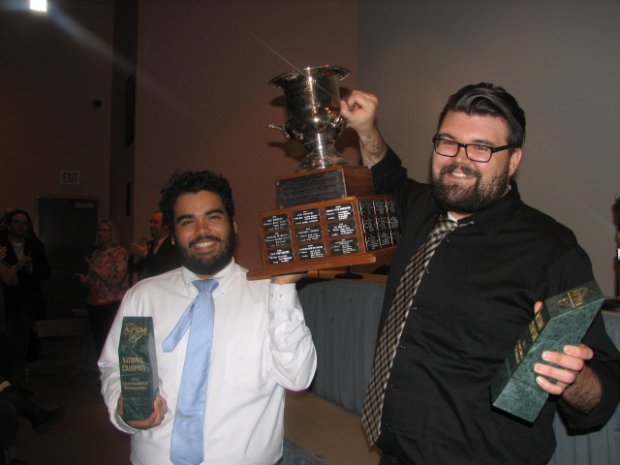
NPDA National Champions
from SIU, Josh Rivera and Ben Campbell
Despite losing in elimination rounds sooner than desired, all three teams competed very well at one of the toughest tournaments of the year. The team took 11th overall in tournament sweepstakes for the NPDA National Championship, and Caitlin Bull and Sam Cook won 10th and 7th Top Speaker Awards for the tournament, respectively. The tournament champions were Josh Rivera and Ben Campbell from Southern Illinois University, the school who won both the NPDA and NPTE championships in the 2012-2013 season.

Next year will be even better for UT Tyler Debate! If you want to have a better look at how the tournament played out over the three days of competition, you can see individual round results and cumulative results at parlitournament.com. There will also be videos uploaded on net-benefits.net from individual rounds in the NPTE and NPDA tournaments very soon. Support the UT Tyler Parliamentary Team in the 2014-2015 season!

Saturday, March 15, 2014

UT Tyler Debate Team Holds Demonstration Debate

Interested in seeing what the UT Tyler Debate team spends so much time doing? On March 5th, a demonstration debate featuring the team was held at 5 PM in the administration building to give any interested parties a look at what the team spends time preparing for. 

Thursday, March 6, 2014

College Board Announces New Plans for the SAT


The College Board announced on Wednesday, March 5th, their plans for changing the SAT. Saying that the test does not focus enough on the academic skills most important for higher education and the working world, the main changes are the elimination of obligatory essays, removing the penalty for guessing wrong on the provided questions, and cutting obscure vocabulary words from the Reading section that are not applicable or relevant within higher education.

David Coleman, College
Board President
David Coleman, president of the College Board, argued that the SAT "has become disconnected from the work of our high schools." A large motivator for the change comes from the common criticism that high school grades are a better predictor for success in higher education than standardized testing, so much so that some colleges have made these test grades an optional portion of the application and enrollment processes. The changes are meant to bring the test back to the same wheelhouse as the topics discussed in high school settings, thus allowing for a better metric of success for students intending on applying for college.

Along with the announcement of the changes to the SAT, Mr. Coleman announced new policy changes for The College Board. First, if a student qualifies, they can receive four fee waivers to apply to colleges, free of charge. They will also be offering free online practice problems from previous tests, along with instructional videos showing how to solve them.

The changes to the SAT are quite extensive. Beginning with the reading section, the vocabulary used will be shifted to what College Board considers to be "rarefied" to words that are common in the college setting. The math questions, once varying over a litany of different areas and topics, will not be focused on linear equations, functions and proportional thinking. The essay section, once mandatory, will now be an optional portion at the end of the test, along with a separate score. The test will be offered on both paper and on a computer. Finally, the scoring metric will revert back to a 1600 range, where a student's top score on the Math section and the "Evidence-Based Reading and Writing" can be 800, each.

This exam will be released in the Spring of 2016. Are these changes good for the test as a whole? Are these changes that could potentially bring the test in line with what is learned within the average high school? High school testers, along with college admissions offices, will make that determination in 2016.


Monday, March 3, 2014

UT Tyler Debate to compete at NPDA National Tournament

While sports teams have their playoffs that drag out for several weeks at a time, debate teams only have one big culmination of their entire year.  For UT Tyler, we compete at two separate national tournaments that offer us a chance to win big against other colleges across the country.  From March 21st until March 23rd, UT Tyler Debaters Dallas Flick, Carver Hodgkiss, Steven Hullum, Kaleb Drake, Samuel Cook, and Kaitlyn Bull will compete against over 150 other teams at the National ParliamentaryDebate Association’s (NPDA) National Tournament hosted by Northern Arizona University in Flagstaff, Arizona.


Prior to competing at NPDA, the team will compete at the National Parliamentary Tournament of Excellence (NPTE), also hosted by NAU.  You will be able to find Dallas’s blog explaining that tournament soon if it is not already available.

There are a couple of differences between the two tournaments.  The first is the topics that are debated. At the NPTE, every single topic of debate is announced beforehand.  In fact, we are already deep into research and preparation for those topics as we speak.  At NPDA, we have no clue what topics we will be debating and we will not find out the given topic for each round until 20 minutes before the scheduled start time. 

The second difference is the structure of the tournament.  At the NPTE, there are 6 preliminary rounds in which 2 judges will make a decision about the round.  The goal for each team is to win as many individual ballots from judges as they can in the first 6 rounds.  For example, if you win your round on a 2 to 0 decision, then you have acquired 2 ballots.  If you win your round on a 1 to 1 decision, then you only have 1 ballot.  A team has to have at least 6 ballots to advance to elimination rounds. 

After the prelim rounds, the tournament then enters into a double elimination style, where you can only lose 2 elimination rounds until you are eliminated from the tournament.  This will continue until there are only two teams left in competition.

At NPDA, there are 8 preliminary rounds with only one judge per round, so it is similar to the other tournaments that the team has attended this year.  After the 8 preliminary rounds, half of the field will advance to a partial-triple-octafinal round.  NPDA elimination rounds are single elimination, so if you lose once, then you are out of the tournament. 

The team hopes to achieve success, as we have been working hard since July to hone skills, garner knowledge, and improve as debaters. Want to monitor the teams progress at the NPTE? You can watch for UT Tyler FH, UT Tyler DH, and UT Tyler BC on each individual round to see how we are doing!


Sunday, March 2, 2014

Debunking Debate- The NPTE


This year, the UT Tyler Parliamentary Debate Team has traveled to six different universities and competed in 9 tournaments, all of which were both challenging or rewarding. All of this effort, however, is to gain momentum for our toughest tournament of the year: The National Parliamentary Tournament of Excellence (NPTE). 

The NPTE is an invitation-only national championship tournament that hosts teams that qualify based on their season-long performances at various tournaments. The point system utilized by the NPTE organization weighs the performance of the teams based on the number of preliminary and elimination debates won or lost at each tournament, as well as bonuses for breaking to elimination rounds, as well as winning the tournament. Seeding from these ranks determines who will be debating in the first round of the tournament (so, for instance, Carver and I already know that we will be debating The University of Utah in the first round of the tournament).
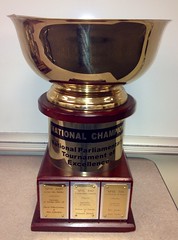
The NPTE Championship Trophy

The NPTE is a traveling tournament, meaning that each year, the event is hosted by a different university. For instance, in 2012 it was held at Western Washington University in Bellingham, Washington; last year, it was held at The University of Nevada, Reno, in Reno, Nevada; and this year, it is being hosted by Northern Arizona University in Flagstaff, Arizona. One of the best parts of this tournament is that it varies in location from year to year, providing a great opportunity for the debate teams to travel to locations in the United States they had never been.  

Like previous tournaments, the NPTE will be a topic-area tournament. Like I wrote about in November regarding the Washburn Tournament, a topic-area tournament releases controversy areas and/or resolutions 3-4 weeks prior to the tournament, allowing for teams to adequately prepare for debates, as well as increase the depth and quality of arguments that will be read against other high caliber teams. The difference between the NPTE and previous tournaments is that while they release controversy areas, they also release the exact resolutions that will be used for the tournament. That way, the debaters know exactly what strategic options the other debaters have prior to the tournament. 

Here is a list of the resolutions that will be used:

Africa
1. The United States federal government should fulfill the United Nations Multidimensional Integrated Stabilization Mission in Mali troop and equipment mandate.
2. The United States federal government should significantly increase unexploded ordnance cleanup efforts in Somalia.
3. The United States federal government should significantly increase its provision of disease monitoring and treatment to South Sudan.
4. The United States federal government should engage in significant civil society development projects within Libya.

5. The United States federal government should provide significant air support to aid in the stabilization of South Sudan.
6. The United States federal government should significantly increase access to neonatal and/or prenatal care in the Central African Republic.

Energy
1. The United States federal government should nationalize energy production in the United States.
2. The United States federal government should substantially increase its investment in hydroelectric power infrastructure projects in the United States.
3. The United States Department of Defense should adopt a policy to use exclusively renewable fuels in all military operations.
4. The United States federal government should increase the usage of microgeneration in the United States.

5. The United States federal government should increase its incentives for the development of methane hydrates within its exclusive economic zone. 
6. The United States federal government should substantially increase its investments in syngas infrastructure in the United States.


Pollution
1. The United States federal government should adopt a policy to significantly decrease the use of phosphorus based fertilizers in the United States.
2. The United States federal government should adopt a policy to significantly reduce the amount of herbicides used in forests in the United States.
3. The United States federal government should take regulatory action to decrease the occurrence of water-borne diseases in the United States.
4. The United States federal government should significantly curtail its efforts to control invasive species.

5. The United States federal government should substantially increase environmental regulations on chemical storage facilities in the United States.
6. The United States should ratify and implement the Stockholm Convention on Persistent Organic Pollutants.
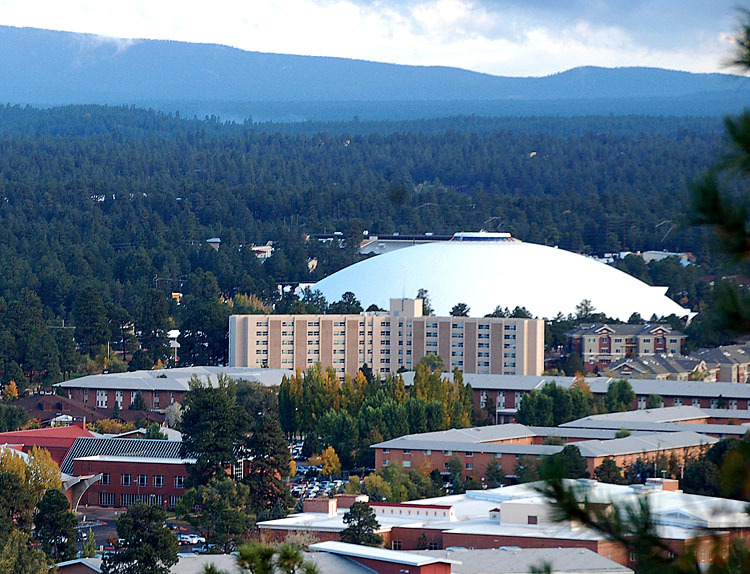
Northern Arizona University, in Flagstaff, Arizona 


The tournament will begin on March 16th and end on March 18th. It begins with all teams competing in six preliminary rounds, with two judges in each round. Breaking to out rounds requires a certain minimum of ballots, determined by the number of teams at the tournament, how many are to break, and what the field looks like in terms of record throughout the tournament. Two years ago, the number needed to break was 7, and last year, it was 6. While that may seem easy, given that the majority of the teams at the tournament are highly experienced debaters, it makes into quite the challenge.

UT Tyler will leave for Flagstaff on March 13th, and will return on the 24th, following the second national tournament, the National Parliamentary Debate Association National Tournament. Keep up with results on a round-by-round basis at parlitournament.com, and also keep up with parli news and events at net-benefits.net.