Showing posts with label Debate. Show all posts

Tuesday, July 22, 2014

How Carver Elects to Spend his Summers at UT Tyler

Finals of the TSDC
end of camp tournament
Summer is an exciting time for students.  School lets out, and all obligations are abandoned.  Most college
students take some time to get caught up on sleep or start getting caught up on TV shows and books that they have been putting off because of school work.  Me? I go and work at Debate Camps across East Texas. While the hours are often long and grueling, the reward is invaluable.

Tuesday, June 24, 2014

Representing UT Tyler at the NSDA National Debate Tournament

With the UT Tyler Debate team's season ending over three months ago, members of the team often find high schools that are looking for assistance with their tournaments or for consulting on how to improve their performance.  The members of the team will often volunteer their services to help those schools improve. Last week marked the end of the high school speech and debate season.  I had the pleasure of attending the week long tournament and judging many rounds of humurous, dramatic, and duo interpretation, and 12 debate
 rounds. It was a pleasure to watch so many excellent performances and
witness the future of speech and debate.
This was the where the finals rounds were held.
The auditorium held 4000 people!

Thousands of high school speakers and debaters converged on Kansas City, Kansas last Monday to begin their competition.  Students began competing at 8 AM on Monday morning, and some did not finish competing until late on Thursday or Friday evening. During the first two days, students competed in their main events: Humorous Interpretation, Dramatic Interpretation, Duo Interpretation, Original Oratory, Congressional Debate, Public Forum Debate, Lincoln Douglas Debate, and Policy Debate. Through 6 preliminary rounds of competition, the top 60
This is how elimination roudns were
announced.  If your "code" was on the
paper, then you had advanced to
the next round!
advanced to the next two elimination rounds.  After an additional 2 rounds of competition, the top 30 in each event were advanced, and so on until only 6 or 7 were left in each event. For debate events, competition continued until only 2 teams remained.

After a student was eliminated from their main event, they had the option to register for a supplemental and cancellation events.  These consisted of Storytelling, Expository Speaking, Prose Reading, Impromptu Speaking, Poetry Reading, Commentary Speaking, and Extemporaneous Debate. I had the pleasure of judging 2 rounds of Humorous Interpretation, 2 rounds of Duo Interpretation, and 4 rounds of Extemporaneous Debate.  It was awesome to see what students had been working on all year in preparation for this tournament.  The future is bright for the National Speech and Debate Association.

Tuesday, April 15, 2014

Critical Thinking, Personal Experience, and Dialogue on Facebook

   My recent blog on Sexual Assault Awareness Month, if you read it, highlighted some of the ways that our own experiences can shape our perspectives, but opinion alone should not always the sole element that defines our perspective. One must understand the perspective of others. It is always hard to wrestle with different notions that confront our own gender/religious/social world view. Here are some things to think about when we debate and/or use our Critical Thinking abilities in dialogue with others.

Thursday, April 3, 2014

UT Tyler Debate Ranks Top 20 in Nation

From March 16th to the 18th, 3 teams from the University of Texas at Tyler competed among the top 58 Parliamentary Debate teams in the country at the 2014 National Parliamentary Tournament of Excellence. Dallas Flick and Carver Hodgkiss (UT Tyler HF), Stephen Hullum and Kaleb Drake (UT Tyler HD), and Sam Cook and Kaitlin Bull (UT Tyler BC) competed against the best of the best, ranking among the top 20 in the country.

Saturday, March 29, 2014

Debunking Debate: UT Tyler Competes at the NPDA Championship Tournament


On Thursday, March 13th, the UT Tyler Parliamentary Debate Team traveled to Northern Arizona University in Flagstaff, Arizona, for our national tournaments: the National Parliamentary Tournament of Excellence, and the National Parliamentary Debate Association Championship Tournament.  The trip lasted 11 days, consisting of 6 days of competition over both tournaments. Carver will be writing about the NPTE later this week, and I will be writing about the NPDA Championship Tournament.

The NPDA is often called "The People's Tournament," primarily stemming from it's sheer entry size and the propensity for underdogs to go very far in elimination rounds. The tournament consisted of over 150 teams from 52 different schools. There were eight preliminary rounds, followed by six elimination rounds, consisting of teams that had at least a 5-3 record in their prelim rounds.

UT Tyler FH
UT Tyler had three teams competing in the NPDA this year: UT Tyler FH (Dallas Flick and Carver Hodgkiss), UT Tyler DH (Kaleb Drake and Steven Hullum), and UT Tyler BC (Caitlin Bull and Sam Cook). UT Tyler FH is a junior-sophomore team, DH is a freshman-freshman team, and BC is a sophomore-freshman team.

After a rigorous set of preliminary rounds for all three teams, FH finished 6-2 to take the 18th seed in elimination rounds, BC finished 5-3 to take the 29th seed, and DH finished 5-3 to take the 33rd seed. It was a fantastic accomplishment to have all three teams break to elimination rounds, given the massive amount of competition at the tournament, as well as the relatively young nature of the teams that were competing for UT Tyler.

In the first elimination round, triple octo-finals, the resolution was "The United States Federal Government should significantly reduce its corporate tax rate." FH was affirmative against Texas Tech RR, BC was negative against Lewis & Clark GP, and DH was negative against Northern Arizona University RS. FH won their round on a 3-0, BC won on a 2-1, and DH lost in a very close round on a 2-1 decision. Carver and I are especially proud of Steven Hullum and Kaleb Drake for their performance at this tournament, seeing as they were two freshman who only debated together for three tournaments, including both national tournaments.

The second elimination round, double octo-finals, had the resolution "The United States Federal Government should significantly increase restrictions on domestic use of unpiloted aerial vehicles in U.S. airspace." FH was negative against Washburn KM, and BC was affirmative against Western Washington HT. Both teams were eliminated in this round: FH on a 3-2 loss, and BC on a 4-1.

SIU Debate Team
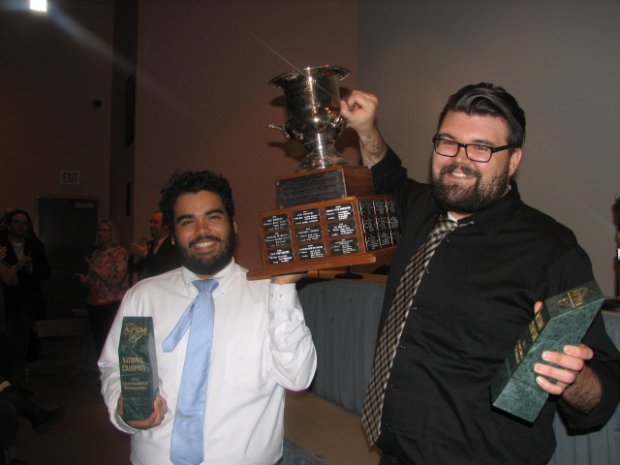
NPDA National Champions
from SIU, Josh Rivera and Ben Campbell
Despite losing in elimination rounds sooner than desired, all three teams competed very well at one of the toughest tournaments of the year. The team took 11th overall in tournament sweepstakes for the NPDA National Championship, and Caitlin Bull and Sam Cook won 10th and 7th Top Speaker Awards for the tournament, respectively. The tournament champions were Josh Rivera and Ben Campbell from Southern Illinois University, the school who won both the NPDA and NPTE championships in the 2012-2013 season.

Next year will be even better for UT Tyler Debate! If you want to have a better look at how the tournament played out over the three days of competition, you can see individual round results and cumulative results at parlitournament.com. There will also be videos uploaded on net-benefits.net from individual rounds in the NPTE and NPDA tournaments very soon. Support the UT Tyler Parliamentary Team in the 2014-2015 season!

Saturday, March 15, 2014

UT Tyler Debate Team Holds Demonstration Debate

Interested in seeing what the UT Tyler Debate team spends so much time doing? On March 5th, a demonstration debate featuring the team was held at 5 PM in the administration building to give any interested parties a look at what the team spends time preparing for. 

Monday, March 3, 2014

UT Tyler Debate to compete at NPDA National Tournament

While sports teams have their playoffs that drag out for several weeks at a time, debate teams only have one big culmination of their entire year.  For UT Tyler, we compete at two separate national tournaments that offer us a chance to win big against other colleges across the country.  From March 21st until March 23rd, UT Tyler Debaters Dallas Flick, Carver Hodgkiss, Steven Hullum, Kaleb Drake, Samuel Cook, and Kaitlyn Bull will compete against over 150 other teams at the National ParliamentaryDebate Association’s (NPDA) National Tournament hosted by Northern Arizona University in Flagstaff, Arizona.


Prior to competing at NPDA, the team will compete at the National Parliamentary Tournament of Excellence (NPTE), also hosted by NAU.  You will be able to find Dallas’s blog explaining that tournament soon if it is not already available.

There are a couple of differences between the two tournaments.  The first is the topics that are debated. At the NPTE, every single topic of debate is announced beforehand.  In fact, we are already deep into research and preparation for those topics as we speak.  At NPDA, we have no clue what topics we will be debating and we will not find out the given topic for each round until 20 minutes before the scheduled start time. 

The second difference is the structure of the tournament.  At the NPTE, there are 6 preliminary rounds in which 2 judges will make a decision about the round.  The goal for each team is to win as many individual ballots from judges as they can in the first 6 rounds.  For example, if you win your round on a 2 to 0 decision, then you have acquired 2 ballots.  If you win your round on a 1 to 1 decision, then you only have 1 ballot.  A team has to have at least 6 ballots to advance to elimination rounds. 

After the prelim rounds, the tournament then enters into a double elimination style, where you can only lose 2 elimination rounds until you are eliminated from the tournament.  This will continue until there are only two teams left in competition.

At NPDA, there are 8 preliminary rounds with only one judge per round, so it is similar to the other tournaments that the team has attended this year.  After the 8 preliminary rounds, half of the field will advance to a partial-triple-octafinal round.  NPDA elimination rounds are single elimination, so if you lose once, then you are out of the tournament. 

The team hopes to achieve success, as we have been working hard since July to hone skills, garner knowledge, and improve as debaters. Want to monitor the teams progress at the NPTE? You can watch for UT Tyler FH, UT Tyler DH, and UT Tyler BC on each individual round to see how we are doing!


Sunday, March 2, 2014

Debunking Debate- The NPTE


This year, the UT Tyler Parliamentary Debate Team has traveled to six different universities and competed in 9 tournaments, all of which were both challenging or rewarding. All of this effort, however, is to gain momentum for our toughest tournament of the year: The National Parliamentary Tournament of Excellence (NPTE). 

The NPTE is an invitation-only national championship tournament that hosts teams that qualify based on their season-long performances at various tournaments. The point system utilized by the NPTE organization weighs the performance of the teams based on the number of preliminary and elimination debates won or lost at each tournament, as well as bonuses for breaking to elimination rounds, as well as winning the tournament. Seeding from these ranks determines who will be debating in the first round of the tournament (so, for instance, Carver and I already know that we will be debating The University of Utah in the first round of the tournament).
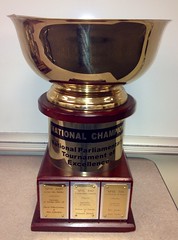
The NPTE Championship Trophy

The NPTE is a traveling tournament, meaning that each year, the event is hosted by a different university. For instance, in 2012 it was held at Western Washington University in Bellingham, Washington; last year, it was held at The University of Nevada, Reno, in Reno, Nevada; and this year, it is being hosted by Northern Arizona University in Flagstaff, Arizona. One of the best parts of this tournament is that it varies in location from year to year, providing a great opportunity for the debate teams to travel to locations in the United States they had never been.  

Like previous tournaments, the NPTE will be a topic-area tournament. Like I wrote about in November regarding the Washburn Tournament, a topic-area tournament releases controversy areas and/or resolutions 3-4 weeks prior to the tournament, allowing for teams to adequately prepare for debates, as well as increase the depth and quality of arguments that will be read against other high caliber teams. The difference between the NPTE and previous tournaments is that while they release controversy areas, they also release the exact resolutions that will be used for the tournament. That way, the debaters know exactly what strategic options the other debaters have prior to the tournament. 

Here is a list of the resolutions that will be used:

Africa
1. The United States federal government should fulfill the United Nations Multidimensional Integrated Stabilization Mission in Mali troop and equipment mandate.
2. The United States federal government should significantly increase unexploded ordnance cleanup efforts in Somalia.
3. The United States federal government should significantly increase its provision of disease monitoring and treatment to South Sudan.
4. The United States federal government should engage in significant civil society development projects within Libya.

5. The United States federal government should provide significant air support to aid in the stabilization of South Sudan.
6. The United States federal government should significantly increase access to neonatal and/or prenatal care in the Central African Republic.

Energy
1. The United States federal government should nationalize energy production in the United States.
2. The United States federal government should substantially increase its investment in hydroelectric power infrastructure projects in the United States.
3. The United States Department of Defense should adopt a policy to use exclusively renewable fuels in all military operations.
4. The United States federal government should increase the usage of microgeneration in the United States.

5. The United States federal government should increase its incentives for the development of methane hydrates within its exclusive economic zone. 
6. The United States federal government should substantially increase its investments in syngas infrastructure in the United States.


Pollution
1. The United States federal government should adopt a policy to significantly decrease the use of phosphorus based fertilizers in the United States.
2. The United States federal government should adopt a policy to significantly reduce the amount of herbicides used in forests in the United States.
3. The United States federal government should take regulatory action to decrease the occurrence of water-borne diseases in the United States.
4. The United States federal government should significantly curtail its efforts to control invasive species.

5. The United States federal government should substantially increase environmental regulations on chemical storage facilities in the United States.
6. The United States should ratify and implement the Stockholm Convention on Persistent Organic Pollutants.
Northern Arizona University, in Flagstaff, Arizona 


The tournament will begin on March 16th and end on March 18th. It begins with all teams competing in six preliminary rounds, with two judges in each round. Breaking to out rounds requires a certain minimum of ballots, determined by the number of teams at the tournament, how many are to break, and what the field looks like in terms of record throughout the tournament. Two years ago, the number needed to break was 7, and last year, it was 6. While that may seem easy, given that the majority of the teams at the tournament are highly experienced debaters, it makes into quite the challenge.

UT Tyler will leave for Flagstaff on March 13th, and will return on the 24th, following the second national tournament, the National Parliamentary Debate Association National Tournament. Keep up with results on a round-by-round basis at parlitournament.com, and also keep up with parli news and events at net-benefits.net.

Sunday, February 2, 2014

UT Tyler Debate Competes at the Mile High Swing


The University of Utah at
Salt Lake City, Utah
Last weekend, on January 18-20, the UT Tyler Parliamentary Debate team traveled to the University of Utah in Salt Lake City, Utah to compete at the Mile High Swing, a two-tournament weekend hosted by the University of Utah and Texas Tech University.  With over 90 teams in attendance, the tournament is considered to be the most challenging invitational of the competition season, and is a strong predictor for how individual teams perform at the national tournaments in March.

The tournament is called the “Mile High Swing” because it was originally hosted at the University of Denver for a number of years, but then became a traveling tournament. It was been hosted at venues such as Texas Tech University, Western Washington University, Colorado College, and most recently, the University of Utah.

The first tournament in the swing, hosted by Texas Tech University, was a topic area tournament.  Like the tournament held at Washburn University in November, controversy areas were previously announced for competitors to base their arguments around.  These were the areas debated in eleven rounds of competition over a day and a half:

The United States federal government should substantially reduce limitations on civil torts in the United States in one or more of the following areas: statute of limitations on filings, availability of class action lawsuits, caps on damages.

The United States federal government should substantially improve their relationship with the Republic of India in one or more of the following areas: immigration, trade, military sales, and/or minority relations.


The United States should adopt one or more of Robert McChesney’s proposals for mass media reform.


The United States federal government should substantially increase its oversight and/or restrictions on the National Security Administration and/or the Foreign Intelligence Surveillance Court.


The United States federal government should significantly increase regulations on securities and trades in the United States.


UT Tyler entered three teams in this tournament: UT Tyler FH (Dallas Flick and Carver Hodgkiss), UT Tyler DH (Kaleb Drake and Steven Hullum), and UT Tyler BC (Caitlun Bull and Sam Cook).  In the first half of the tournament, BC and DH broke to elimination rounds, both losing in the double octofinal round to Texas Tech University and Northern Arizona University, respectively.  In this tournament, the UT Tyler teams were able to best teams from notable universities such as UC Berkeley, Air Force Academy and the University of the Pacific.

The second half of the tournament was held in the conventional tournament format, with topics that are not previously disclosed, but instead based solely on current issues and events.  The same three teams entered, and all three broke to elimination rounds on the final day of competition.  DH and BC both were bested in the triple octofinal round by McKendree University and Point Loma University, respectively, on a topic regarding ownership recognition of the Senkaku Islands.  FH won that round against the University of Utah, and lost in the double octofinal round to William Jewell College on a topic regarding removing the tax exemption of religious institutions in the United States.  In this half of the tournament, UT Tyler conquered over teams from schools such as the University of Colorado Boulder, University of Puget Sound, and the University of Nevada at Reno.
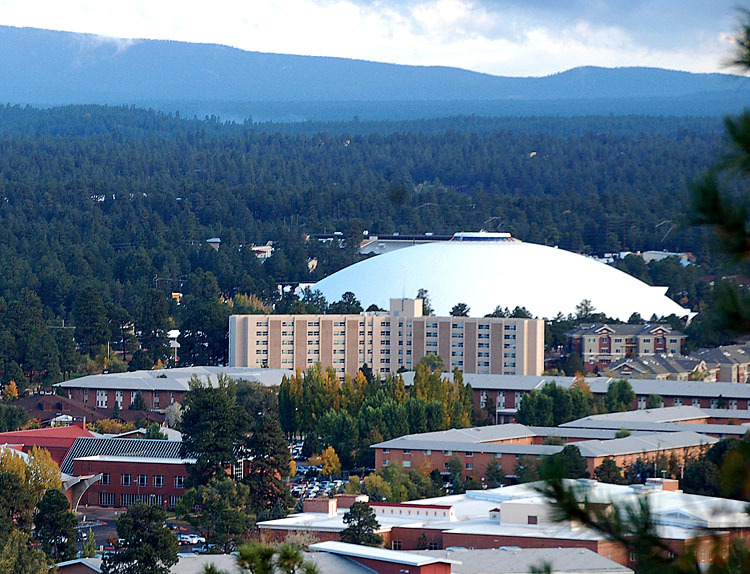
Northern Arizona University at Flagstaff, Arizona

The next tournament for the entire team will be our national tournament at Northern Arizona University in Flagstaff, Arizona- the National Parliamentary Tournament of Excellence.  Tournament preparation will begin in late February, and the tournament begins on the last weekend of Spring Break.  Keep up with results at parlitournament.com, and check out npte.debateaddict.com to see who will be competing in the tournament.

Saturday, November 2, 2013

UT Tyler Debate Teams Rank among the nation’s best

Rankings were recently released of the top Parliamentary Debate Teams in the nation, and the University of Texas at Tyler had 2 teams very highly ranked.  Samuel Cook and Caitlin Bull were ranked 9th, and Dallas Flick and Carver Hodgkiss were ranked 11th!

Tuesday, October 15, 2013

UT Tyler Forensics goes to Portland, Oregon!

UT Tyler FH vs. Lewis and Clark MH
On Friday, October 4th, at 5:00 AM, the University of Texas at Tyler Debate Team pulled out of the parking lot and began a 2 hour drive to the Dallas/Fort Worth International Airport, where a plane would then fly them almost 4 hours to attend the 2013 Steve Hunt Classic - a speech and debate tournament that would feature more than 40 universities from all across the country.

Thursday, September 26, 2013

Debunking Debate: an explanation of what we do during the weekends

Dallas and I debating a team from Pacific University
Often times, when I tell people that I am a member of the debate team at UT Tyler, they assume that I dress up like a presidential candidate, stand behind a podium, and waive my fist passionately about a topic of importance.  However, this is not even close to what we do. Pretty soon, you are going to start seeing posts from both Dallas and myself about the tournaments that we are attending, and I figured that you would like some explanation of what we do.

Here at the University of Texas at Tyler, we compete in what is called Parliamentary Debate.  It is a form of debate in which two teams (one affirming the topic and one negating the topic) of two people engage in a discussion of a topic that is announced 20 minutes prior to the time of the debate round.  The majority of the time, the topic, or the resolution, is in the form of a policy action that a certain actor should take.  A resolution would look something like this: “The United States should take actions to significantly improve relations with Japan.

After a resolution is announced, each team is given 20 minutes to prepare their positions.  Most of the time, our positions have already been prepared and it is just a matter of writing down all of our arguments before the 20 minutes expires.  Normally, the debate team spends several hours a day, and every weekend writing and preparing our arguments for resolutions that we think may be at a particular tournament. 

Each round lasts approximately 45 minutes, and each team gives 3 speeches, receiving an equal division of speaking time.  The first affirmative speech is allocated 7 minutes to present a “case,” which includes a statement of policy intent and a discussion of advantages to taking the policy action aforementioned. 
The next speech is given by the negative team.  The first negative is allocated 8 minutes to discuss potential disadvantages to passing the policy action from the affirmative as well as making arguments against the case that was read by the first affirmative.

Next, the second affirmative speaker has 8 minutes to answer all of the argumentation brought up by the first negative speaker.  This includes answering all of the disadvantages as well as going argument by argument, or line by line, on the arguments made against the affirmative case.
The next speech is given by the negative, and is another 8 minute speech.  The role of this speech is to condense the negative arguments into a select few in order to make it extremely easy for the judge to vote for the negative. 

This next speech is the first and only negative rebuttal.  It is only 4 minutes in length, and the role of this speech is to provide a narrative as to why the judge should vote for the negative.  Whereas the previous speech sort of does housecleaning and does more on winning the debate argument by argument, this rebuttal is to ensure that the judge receives a proper narrative as to what the disadvantages and fallacies of the affirmative case are.

The next speech is also the final speech in the round, and it is the affirmative rebuttal.  The purpose, much like that of the negative rebuttal, is to provide a narrative as to why the judge should vote for the affirmative, while also pointing out where the affirmative is winning argument by argument.  The only difference is that this speech is 5 minutes, rather than 4.

Hopefully you now have a little better idea of what it is that we do, so that when you read Dallas's upcoming blog about our first tournament, then you can understand what exactly we were doing during our tournament, and what it looked like.

If you are interested in any additional information, then I am going to provide you a couple of additional links.  First, if you are interested in looking at the tournaments that we competed in and would like to watch our progress, then click here.  To navigate that page, you simply click first on the name of the tournament, and then you click on each round you would like to see the result of.  You can also see the resolution for each round, if you are interested.  For Dallas and I, look for "UT Tyler FH." 

If you are interested in national rankings of teams, then click here.  Postings of rankings will not be up yet, but we should see them fairly soon, so keep a look out! Again, our team name is "UT Tyler FH."

Finally, if you are interested in seeing what an actual round looks like and what tournaments feel like, then feel free to watch the video below.  Be warned, it does contain some use of adult language.  Although the video is about the Kansas Debate Team, our team at UT Tyler has the same passion for what we do and the same work ethic.  To watch the video, click here.

I have also been toying with the idea of making this sort of a series where I discuss numerous different aspects of debate, like the speaking style of debate and what the community is like.  If that sounds like something you would be interested in, then let me know in the comments!


Wednesday, August 7, 2013

Giving back to the High School Debate Community

Being a member of the UT Tyler debate team means that I don’t have a lot of weekends to do things, and I very rarely have time to leave Tyler just because we are usually working at the debate office.  However, the past couple of weeks I have had the great opportunity to help give back to the community that made me who I am.

Every summer, hundreds of high school debaters pay to attend debate camps across the state of Texas. I had the fortune of working at one a couple of weeks ago.  I was on staff at the Texas Speech and Debate Camp, hosted by East Texas Baptist University. 

Together, with 4 other staff members, we helped almost 30 debaters from the east Texas high school debate community work on their policy debate skills.  This was my second year working at the camp, but my experience was even better than last year!

The camp was a week long, and featured a variety of lectures from each of the staff members as well as plenty of practice rounds for each of the debaters to participate in, followed by a tournament at the end of the camp to allow the debaters to utilize some of the skills that they had developed while at the camp.  For those that follow the blog and read my last post about the camp that I attended as a student, it was a very similar schedule and format for the camp. 

I couldn't have asked for a better group of people to work with.  I had such a great time working and helping students develop their skills as debaters.  It was such a joy to work and give back to the community that I was a part of for four years of high school.  My goal has always been to graduate from college and teach high school while coaching debate.  With this camp, I have had the opportunity to get a taste of that life, and I can’t wait. 

I also had the chance to go back to my former high school and help their debate team for a week as they get ready for the upcoming season that starts in less than a month.  It was a week of fun as I helped them prepare their different argumentative positions and helped teach new debaters the basics of policy debate.


Both of these camps were such a blast to work at, and I can’t wait until next summer to do it all again.  I have had such a blast working and helping out this community and I hope that I can continue to do this for many years. I would encourage each student that attends college to not forget about your roots.  If you ever have the opportunity to go and give back to any events you participated in during high school, take advantage of it.  It is always nice to make your community or event a better place.

This is the Student Center, where the campers had time to prepare themselves for the camp tournament while at the Texas Speech and Debate Camp.


Friday, July 26, 2013

Honing our Skills at UT Tyler

Regardless of what activity you participate in at the University of Texas at Tyler, you will have the school’s support.  Two weeks ago I attended the Midwest Debate Cooperative with the rest of the UT Tyler debate team and participated in a week long camp aimed at improving our abilities in debate.  The camp was held at Kansas City Kansas Community College in Kansas City, Kansas, where we had a most excellent time.
You have probably already read from Dallas about how awesome all of the restaurants we ate at were, so I will spare you of the jealousy I would create by mentioning Oklahoma Joe’s again.  In terms of the camp, there are many things I feel are worth mentioning.

                                      Above you can see the building that we spent our week in

Tuesday, June 11, 2013

Dallas' First Blog Post (Yes, Like the City) for the UT Tyler Student Blog


Hello to the followers of the UT Tyler Student Blog!  My name is Dallas Flick, and I am a junior Speech Communication/Political Science major at The University of Texas at Tyler.  I write this introductory post during my first day as a member of the UT Tyler Telecommunications team, which to this point has been an extremely exciting process.  I am very grateful for this position, not only because I have the opportunity to communicate with current and future students at UT Tyler, but also because it is my first employment position that includes air conditioning and desk chairs.

I was born in Denton, Texas, and since then have lived in Texas all my life.  I graduated from Aubrey High School in Aubrey, Texas in May of 2011, and since then have been a full-time student at UT Tyler.  Since my high school years, I have always held an interest in communication, current events, politics, and other social issues, all of which I was able to channel into competitive debate.  After debating in high school for three and a half years, I continued my debate career by enrolling at UT Tyler, and joining the parliamentary debate team on campus.  

Thursday, June 6, 2013

Times Are Changing at the University of Texas at Tyler, and I Couldn't Be More Excited

As Bob Dylan once sang, "For the times they are a-changin'."  My life has taken me on quite the adventure for the past few months.  My name is Carver Hodgkiss and I am one of the newest additions to the UT Tyler Student Blogging team.  I just finished my Freshman year at the University of Texas at Tyler, working towards my ultimate goal of receiving a Bachelor's in History.  This past year has certainly been an interesting one!

To tell you a little more about myself, I am a dork.  There's not much more to me, unfortunately.  I like to play video games, I love to read, and I love to debate (not the arguing kind, but the academically competitive kind.) I try to be funny, but as you will soon find out, I am not very successful.  

The strangest thing for me is that my first year of college is already over!  I feel like it was just yesterday sitting in elementary school trying to calculate the exact number of days until I was "done with school forever."  It has been an excellent year, though.  I have met new people, gotten to travel the country with the UT Tyler Forensics Team, and learned so much about myself - like how much better at procrastinating I have become. 

I am a member of the UT Tyler Forensics Team, and I compete in what is called Parliamentary Debate.  I will likely spend a majority of my time with the Student Blogging Team discussing my adventures with the team.  I can tell you this, though, you will certainly be seeing some awesome pictures  and descriptions of places that we travel.  For example, our national tournament last semester was held at the University of the Pacific in Stockton, California.  I got some excellent pictures of various mountain ranges that we passed along the way.  So get ready!

Bob Dylan was right; the times certainly are changing. I am SO excited to be working for this team! I am looking forward to providing you readers with information regarding my exploits as I progress through the ranks at the University of Texas at Tyler.  

If you want to see some pictures that I have already posted, check out our Tumblr and Pinterest pages!