Showing posts with label UT Tyler Honors Program. Show all posts

Monday, February 3, 2014

Patrick Mureithi visits UT Tyler


On Wednesday, January 29th, the UT Tyler Honors and GATE programs were pleased to welcome filmmaker and documentarian Patrick Mureithi to present his documentary “ICYIZERE:hope.” 

Mureithi is a Kenyan documentary filmmaker who has worked to educate the world about atrocities such as the Rwandan Genocide, and the reconciliation process that thousands still go through to this very day.  He began his presentation by discussing his teenage life while living in Kenya, a country very close to Rwanda. He remembers when he was 17 hearing about the OJ Simpson Trial, Kurt Cobain’s suicide, and the success of Snoop Dogg in 1994, yet he heard nothing of the beginning of the Rwandan Genocide.  He uses this story to highlight the ignorance the world had regarding this tragedy.  Mureithi’s work is to increase the awareness of the events, along with the current day healing process.

ICYIZERE (pronounced ee-cheez-eh-reh) is a documentary that shows the reconciliation process of both survivors and perpetrators of the Rwandan Genocide.  It centers on the reconciliation workshops from the African Great Lakes Initiative of the Friends Peace Teams, a group that holds three day workshops which include 10 people from one side of a conflict together with 10 people from the other side to restore normal relationships between the two sides. Through addressing Post Traumatic Stress Disorder and conducting a series of group exercises that help to build trust, the workshops bring participants to the realization that:

·  “They are more similar than different”
·  “They are all, victim and aggressor, suffering from trauma.”
·  “The most effective way to overcome their trauma is by making an effort to forgive each other     and work toward rebuilding trust within their communities”

Mureithi’s film has been shown in Brazil, the United Kingdom, Kenya, Rwanda, Burundi, Uganda, Zambia, the Democratic Republic of Congo, and on college campuses all over the United States.  For more information on the reconciliation workshop, visit the African Great Lakes Initiative of the Friends Peace Teams website.  To learn more about Mureithi and his upcoming work and projects, visit the Josiah Films website. 

Friday, November 15, 2013

Karen Elliott House Lectures at UT Tyler


Photo-0037
House with Governor Muhammad Bin Nasser 


On Monday, November 11th, The UT Tyler Honors and GATE programs partnered with Ted W. Walters and Associates to sponsor a public lecture from Pulitzer-Prize winning reporter Karen Elliott House.  House discussed her 30 years of writing and reporting on Saudi Arabia, as well as being a diplomatic correspondent, foreign editor and then publisher of The Wall Street Journal.  She also discussed her 2012 book, On Saudi Arabia: Its People, Past, Religion, Fault Lines-and Future. 

House is a graduate of UT Austin, where she received a bachelors in journalism and was the editor of the university’s newspaper, The Daily Texan.  In 1984, she was awarded a Pulitzer Prize in international reporting for her coverage of Middle East while writing for the Wall Street Journal.  Specifically, her interviews with Jordan’s King Hussein and the discussion of the Middle East peace plan from the Reagan Administration gained a large amount of international recognition.  Following this recognition, she began her research and visits to Saudi Arabia, learning about the political and social structure of the country.

House identifies the three pillars that Saudi Arabia is built on: the Saudi political dynasty, the theology of Wahhabism, and the oil market.  She argues that these three historic pillars of Saudi stability are cracking for various reasons.  

Saudi Arabia’s oil revenues, which is valued at roughly $43 billion per year for the country, is currently being threatened by peaked production and a massive increase in domestic energy consumption.  Domestic subsidies for oil production is currently at 52 cents per gallon of gas, a tremendously high rate for a country that relies on their oil market for about 86% of its annual revenue.  The United States was predicted to be the world’s leader in oil production by 2015, creating a scenario for Saudi Arabia where competition for oil dominance is more of an uphill battle than ever. 

Wahhabism is a conservative and intolerant form of Islam that is practiced in Saudi Arabia.  At one point in the country’s history, there was a supportive Wahhabi Islamic establishment that bestowed legitimacy on the House of Saud (the current royal family in Saudi Arabia).  However, the establishment is not fractious and is decreasing in public credibility.

The current royal family is the House of Saud, and they have been in power in Saudi Arabia for the better part of the past 250 years.  The family is estimated to have roughly 15,000 members, the most influential of which is Abdullah bin Abdulaziz Al Saud, the King of Saudi Arabia.  Recently, the family is in danger of division as they are forced to confront generational succession.  This will lead to allegiances being split and the increase of tensions between higher up members of the royal family, generating a large amount of political strife in the country as a whole.


The University of Texas at Tyler is honored to have Mrs. House visit our campus and lecture on her area of expertise.  Keep track of the UT Tyler Honors and GATE web pages to check for the Spring Semester colloquium.  And if you are interested in learning more about what Mrs. House has been researching for nearly thirty years, check out her book!  

Saturday, September 28, 2013

UT Tyler Honors Colloquium Event: Forensic Pathology 101


On Tuesday, September 24th, the UT Tyler Honors Program hosted a lecture from Dr. Scott Kornman, MD, FCAP, titled “Forensic Pathology 101” in the University Center Theater.  Dr. Kornman is a Forensic Pathologist who began his career for the US Air Force, and after working at several hospitals and medical centers, he now works at the Diagnostic Clinic of Longview in Longview, Texas.  He is also the father of current UT Tyler Honors student CJ Kornman, so he was more than happy to speak with students about his profession and its intricacies.

Forensic pathology is a subset of pathology, or the study of disease, that focuses on the determination of cause of death via corpse examination.  Primarily, the function of a forensic pathologist is to determine the cause of death for a person, whether that cause by simple or complex.  Forensic pathologists often perform autopsies on the recently deceased, often times for criminal law cases or civil cases.  They also work identify the body of a deceased individual, which can often be very tasking, dependent on the cause and manner of death of the individual. 

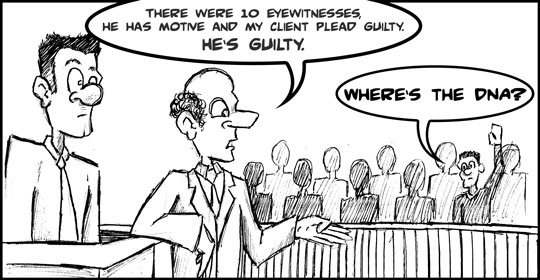
An example of how the "CSI Effect" can affect
 jury deliberation over criminal and civil cases.
This work is highly stylized to the public through television shows such as CSI, Bones, Dexter, Law & Order, etc.  However, according to Dr. Kornman, the entertainment media dramatizes forensic science to an extreme degree, to the point where it is nowhere near accurate to the actual field of study.  Part of the issue lies in the coincidental manner in which the detectives are able to solve cases, along with the relatively short amount of time it takes to solve cases.  He defended the “CSI effect,” which is the misperception that is given to individuals about forensic pathology, leading them to be interested in the field for the wrong reasons.

Dr. Kornman discussed a few of his cases that he has tackled in the past, as well as methods utilized in his practice.   A large amount of his cases revolved around military events, such as training accidents, plane and automobile crashes, and the like.  Later in his career, the majority of his cases involved civilian death ranging from natural, accidental, homicide, and suicide. 


This lecture was ripe with information, and the UT Tyler Honors Program is very grateful that he took the time to share the intricacies of his profession.  We hope he returns in the future to tell us more about forensic pathology!

Note- Be sure to check out the UT Tyler Honors Colloquium page for information about future events and lectures on campus!   

Friday, September 13, 2013

Carl Wieman Lectures at the Cowan Center


On Thursday, September 5th in the Cowan Center, Dr. Carl Wieman visited the UT Tyler campus at the Cowan Center, the first of four in the Cowan Center Distinguished Lecture Series for the school year.  As I discussed previously on this blog, Dr.Carl Wieman won the Nobel Prize in Physics in 1995 for his work with the Bose-Einstein condensate, and has since been heavily involved with improving science education in the high school and collegiate levels.

His lecture on Thursday, titled, “How advances in research on learning can dramatically improve science and engineering education", discussed how using “peer instruction” can innovate the instruction of science, math, technology, and engineering (STEM) for high schools and universities.  “Peer instruction” is a pedagogical system originally created by Eric Mazur, in which teachers repeatedly ask multiple-choice questions to a class, and students rely on group discussions to find a collective response.  Wieman discusses that this practice in classrooms allows students to better analyze given questions and scenarios, rather than rely on teacher walkthroughs to understand solutions.  This is a popular standpoint amongst educators, as they wish to move away from the banking method of education, and move toward a collective thought process for better understanding of a given topic.

While the lecture primarily targets STEM classrooms, I was curious as to how this teaching method applies to classrooms with liberal arts topics, such as Political Science, Communication, Journalism, etc.  While the peer instruction method works successfully in technical classrooms, students in liberal arts classes often utilize the banking method to acquire a set amount of information, while avoiding the injection of ideologies in the discussion that may hinder progress in the classroom.  This is a common criticism of class discussions during lectures; it is challenging to teach subjects that are prone to a negative response from someone who holds a conflicting ideology toward the topic.  This is a criticism that Dr. Wieman is working toward solving for these classrooms, so his method of peer instruction can be more applicable to liberal arts classes.

Remember, Dr. Wieman was the first of four lectures that will happen during the school year.  Soon to follow are Katie Couric, Charles Krauthammer, and Robert Edsel.  Check out the Cowan Center website for ticket and date information. Do not miss a great educational opportunity at UT Tyler! 

Thursday, August 8, 2013

UT Tyler Honors Program, Fall 2013


This will be an exciting year for the Honors Program at The University of Texas at Tyler.  I was fortunate enough to be accepted as an Associate Student into the Honors Program, and now I will get to take part in the fantastic events that the Honors Program is holding throughout the fall semester.  Not only is this an amazing educational opportunity for all of those interested, it is also a chance to meet some of the nation’s brightest minds.

Distribution data that proves the existence
of the Bose-Einstein condensate, a
new phase of matter.
The first major event hosted by the Honors Program will be a lecture from Nobel Prize winning physicist Dr. Carl Wienman in early September of 2013.  In 2001, Dr. Wienman won the Nobel Prize in Physics, along with Eric Allin Cornell and Wolfgang Ketterle, for his work with Bose-Einstein condensate, a branch of research initiated by Albert Einstein and Satyendra Nath Bose that led to developments within particle physics and studies of superfluidity and superconductivity.  He also leads a web-based directive called PhET out of the University of Colorado, which has improved the ways in which physics, chemistry, biology, earth science, and math are taught and studied.  His lecture will be inspiring to those who are seeking a career in science, technology, engineering, and/or math.

Later in the month of September, another science-based lecturer will visit UT Tyler to discuss Forensic Pathology.  Dr. Scott Kornman, MD, works out of the Diagnostic Clinic of Longview, Texas, and will discuss his branch of scientific research and what he does within his specialized field.  Forensic Pathology is a subset of pathology that focuses on determining the cause of death of an individual via autopsy, or corpse examination.  This line of work is often dramatized by crime television shows such as CSI, even though few reveal the true intricacies of this particular field of science. 

On October 24th, the Honors Program will co-host Global Quiz Night along with the GATE program.  A large group attended the event last year, and it was well worth the visit.  Several student groups competed against each other in quiz-bowl fashion, proving to be a challenge for all competitors.  Groups such as the 
UT Tyler Debate Team, workers from the Patriot Talon, Honors Program members, and many other groups were in the running for top prizes, and it was an exhilarating experience.  Global Quiz Night challenges students to answer questions from a variety of topics, such as global history, arts and literature, science, sports, popular culture, and many others.  Last year, the Debate Team took first prize (holla!) and will be looking for a repeat title.  Perhaps your student group will be the one to step up and win.  Attend Global Quiz Night and find out!


Finally, to wrap up the semester, the Honors Program and GATE will co-sponsor a lecture from Karen Elliot House, author of “Saudi Arabia: Its People, Past, Religion, Fault Lines--and Future.”  House is a former executive of the Wall Street Journal and Dow Jones, and is a Pulitzer Prize winner for her Middle East coverage while working for the Wall Street Journal.  Her book shines light on the mystery that is Saudi Arabia; it details the infamous domestic social structure of the country, as well as the impact the country has on global economics and diplomacy.  Her book gives a fascinating portrayal to one of the last true monarchies in the world, and her lecture will be truly fulfilling to students that wish to explore a career in international politics, diplomacy, or economics.

The fall semester for the Honors Program will be full of exciting opportunities for those involved in on-campus activities.  Be sure to see the full schedule of events for more information.  If you attend these events and enjoy the rich, educational environment, feel free to explore the option of applying for membership in the Honors Program.  If you are still a high school student looking to enroll at The University of Texas at Tyler, consider the possibility of starting your freshman year as an Honors Student!